Fethiye at a glance
| Where | A sheltered bay in Muğla Province, on the Lycian coast of southwest Turkey |
|---|
| Getting there | Dalaman Airport (DLM), 46 km (29 miles), about 50 minutes by car |
|---|
| Time needed | 3 full days |
|---|
| Best time to visit | Late May to mid-October for swimming |
|---|
| Our private tours | Included in our 12-day tour; see it above |
|---|
Summarize this guide with an AI assistant
Where is Fethiye and how do you get there?
Fethiye sits on a sheltered bay in southeastern Muğla Province, in the ancient region of Lycia. The ancient city under the modern town is Telmessos.
- From Dalaman Airport (DLM): about 29 miles (46 km), roughly 50 minutes by private car on the D400 highway. Ölüdeniz is about 40 miles (65 km) and 1.5 hours from the airport. Dalaman has year-round domestic flights from Istanbul and seasonal international flights.
- From Antalya: Antalya Airport (AYT) is a longer option, about 3.5 to 4 hours by road.
- From Pamukkale: about 3.5 hours by road, which makes Fethiye a natural next stop after Pamukkale or Ephesus.
Ölüdeniz, Hisarönü and Kayaköy are a short drive south of town. The Lycian sites of Tlos, Saklıkent, Xanthos, Letoon and Patara lie to the east and southeast in the Xanthos (Eşen) River valley.
How much time do you need?
Three full days covers the essentials: Ölüdeniz and Babadağ, a private boat trip, and Tlos, Saklıkent and Kayaköy. Add a fourth day for Xanthos, Letoon and Patara, and one more for a Lycian Way hike.
What to see in Fethiye and the Turquoise Coast
The area offers two kinds of days, water and mountains or Lycian ruins. Alternate them so you never spend two hot afternoons in a row on exposed stone.
Ölüdeniz and the Blue Lagoon
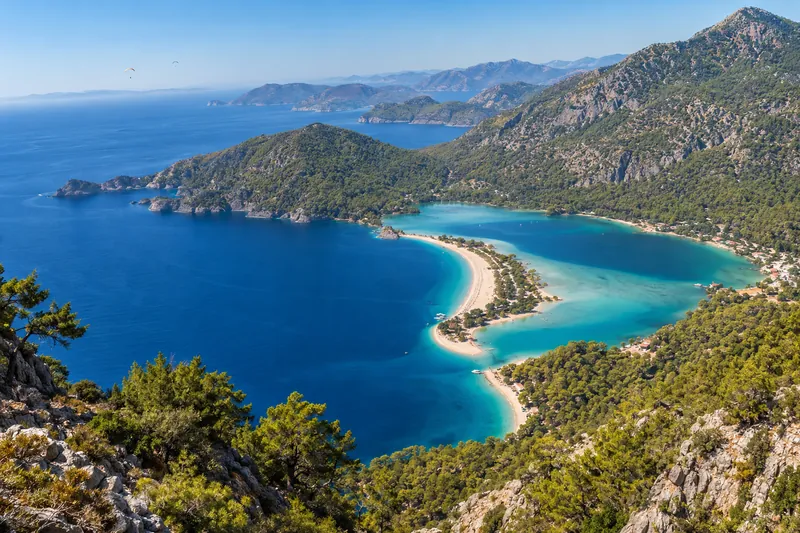
Ölüdeniz means "Dead Sea" in Turkish, a reference to how still the water stays inside the lagoon even when the open sea is choppy. The lagoon and its sand spit, Kumburnu, form the Ölüdeniz Nature Park, a protected area with a small entrance fee. Inside you find shallow, clear turquoise water, sun loungers for rent and pine shade at the back of the beach. The long public beach outside the lagoon is free and is where paragliders land. Arrive early in July and August, when the park fills by midday.
Babadağ paragliding
Babadağ, the mountain rising behind Ölüdeniz, stands about 6,447 feet (1,965 m) high and is one of the busiest paragliding sites in Europe. Licensed operators fly tandem: you are strapped to an experienced pilot, run a few steps off a takeoff ramp at 1,200 to 1,900 m (about 3,900 to 6,200 ft), and glide down to the beach. Flights typically last 20 to 40 minutes. You need no experience, but operators set weight limits and may decline people with back or heart conditions. Non-flyers can ride the cable car up for the classic view down onto the lagoon.
Kayaköy, the abandoned village
Kayaköy, known as Levissi before 1923, is a hillside town of roughly 350 to 400 stone houses, mostly roofless now, with two large churches. Its Greek Orthodox residents left under the 1923 population exchange between Greece and Turkey. An earthquake in 1957 ended permanent life in the old town. Walk up to the Upper Church for the view over the valley. Allow 1 to 1.5 hours, and pair it with lunch in one of the village restaurants below.
Lycian rock tombs and the Tomb of Amyntas
Carved into the cliff above Fethiye town, the Tomb of Amyntas looks like the front of a small Ionic temple, with two columns and a pediment cut straight from the rock. Inscriptions date it to the 4th century BC and name Amyntas, son of Hermapias. Reaching it means a set of steep steps, best climbed in the late afternoon light.
Fethiye Museum
The Fethiye Museum holds finds from Telmessos, Tlos, Letoon and other Lycian sites. Its best-known piece is the Trilingual Stele from Letoon, dated to the 4th century BC and inscribed in Lycian, Greek and Aramaic, which helped scholars read the Lycian language. As of October 2026, the official museum page lists the museum as closed to visitors, so check before you plan around it.
Saklıkent Gorge
Saklıkent is a limestone gorge about 11 miles (18 km) long and up to about 980 feet (300 m) deep, protected as a national park since 1996. It lies about 31 miles (50 km) from Fethiye. You enter on a boardwalk bolted to the cliff, then wade across an icy, fast stream to reach the walkable section, about 2.5 miles (4 km) long. The water is cold even in August, and the gorge is usually walkable only from late spring, once runoff drops.
Tlos
Tlos is one of the oldest Lycian cities and was among the six leading members of the Lycian League, with three votes in its assembly. Its acropolis carries a cluster of temple-fronted rock tombs, a theater, Roman baths and the ruins of an Ottoman-era fortress built by a local strongman, Kanlı Ali Ağa. The site is on UNESCO's Tentative List. It sits on the road to Saklıkent. Allow about an hour.
Xanthos and Letoon (UNESCO)
Xanthos was the capital of ancient Lycia, and Letoon, a few miles away, was its religious sanctuary and the federal shrine of the Lycian League. Together they were inscribed as a UNESCO World Heritage Site in 1988. At Xanthos, look for the pillar tombs, including the Harpy Monument and a sarcophagus raised on a tall pillar, and the Roman theater. The Nereid Monument was taken to England in the 19th century and is now in the British Museum. Letoon has three temples in a row, dedicated to Leto and her children Artemis and Apollo, beside a spring full of frogs, a fitting echo of Ovid's myth in which Leto turns rude villagers into frogs.
Patara Beach
Patara combines a long, wild sand beach with a large ancient city behind the dunes, where you can see a restored council building (the Bouleuterion), a theater and a colonnaded street. The beach is a nesting ground for loggerhead sea turtles, so it closes from 8 p.m. until sunrise during nesting season, roughly May through September. Bring water and shade.
Butterfly Valley
Butterfly Valley (Kelebekler Vadisi) is a narrow, steep-walled valley ending in a small beach south of Ölüdeniz, protected as a nature reserve. It is named for the Jersey tiger moth and dozens of other species, seen mostly in summer. Most visitors arrive by boat from Ölüdeniz. The steep footpath from Faralya is for experienced hikers only.
A private 12 Islands boat trip (gulet)
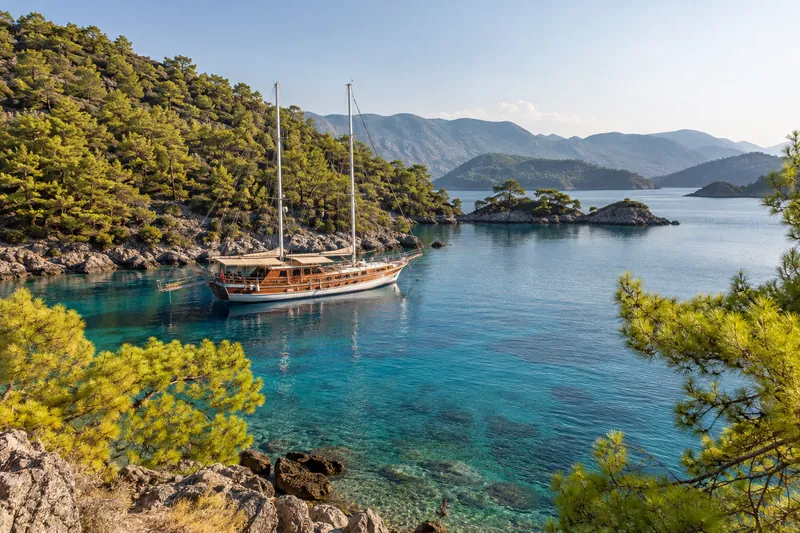
The classic Fethiye day is a boat trip around the islands of Fethiye Bay and the coves along the Göcek side of the gulf. On a private gulet, the traditional wooden motor yacht of this coast, you choose the route, swim stops and lunch time instead of following a crowded party boat. Expect four or five swim stops and lunch cooked on board. The sea is calmest in the morning.
The Lycian Way
The Lycian Way is a waymarked long-distance hiking trail that starts near Ölüdeniz and runs east toward Antalya. It opened in 1999 and, with recent extensions, now measures about 470 miles (760 km). A private guide can arrange a 2 to 4 hour section, such as the stretch above Faralya over Butterfly Valley. Hike in spring or autumn.
Tickets and opening hours (as of October 2026)
State sites price foreign visitors in euros, charged in lira at the daily rate. Children under 8 enter free. Several official listings still show outdated lira prices, so check muze.gov.tr the week you travel.
| Site |
Ticket for foreign visitors |
Hours |
Notes |
| Xanthos |
€3 |
08:30–19:00 (Apr–Oct), 08:30–17:30 (Nov–Mar) |
Open daily. Museum Pass accepted |
| Letoon |
|
09:00–20:00 per official page |
Open daily |
| Tlos |
€3 |
08:30–19:30 summer, 08:30–17:30 winter |
Open daily |
| Patara |
€15 |
|
Includes the beach. Beach closed 8 p.m. to sunrise in nesting season |
| Kayaköy |
|
08:30–19:30 summer, 08:30–17:30 winter |
Official page shows an outdated lira price |
| Tomb of Amyntas |
|
08:30–19:30 summer, 08:30–17:30 winter |
Steep steps |
| Fethiye Museum |
Listed as closed to visitors |
08:30–18:00 when open |
|
| Saklıkent Gorge |
|
|
National park, not a Ministry of Culture site |
| Ölüdeniz Nature Park (lagoon) |
|
|
Protected area; public beach outside is free |
| Babadağ cable car |
|
|
Private operator |
Coming changes: The Ministry's new tariff takes effect on April 1, 2027. It lists Xanthos, Letoon, Tlos, Kayaköy, Amyntas and the Fethiye Museum at €5 each, and Patara at €16 with an audio guide. A Museum Pass covers the Ministry sites above but not the nature park, Saklıkent or the cable car.
Best time to visit
For swimming, late May through mid-October is the window. For ruins and hiking, April to early June and late September to early November are the most comfortable. July and August are hot, with highs around 91°F (33°C).
| Months |
Air (avg high) |
Sea |
Crowds |
Notes |
| March–April |
63–70°F (17–21°C) |
63°F (17°C) |
Light |
Wildflowers, good hiking. Sea too cold for most |
| May |
77°F (25°C) |
68°F (20°C) |
Moderate |
Swim season starts late in the month for most |
| June |
86°F (30°C) |
73°F (23°C) |
Busy |
Excellent for boats and beaches |
| July–August |
91°F (33°C) |
79–82°F (26–28°C) |
Peak |
Ruins early morning only. Book boats ahead |
| September |
86°F (30°C) |
79°F (26°C) |
Busy early, easing |
Warmest sea with lighter crowds |
| October |
77°F (25°C) |
75°F (24°C) |
Moderate |
Still swimmable, comfortable for ruins |
| November–February |
55–66°F (13–19°C) |
63–70°F (17–21°C) |
Very light |
Rainy spells, many boats and beach clubs close |
Guide's tip
Do Saklıkent and Tlos on the same day, but visit Tlos first in the morning while it is cool, then cool off in the gorge in the early afternoon. Keep the boat day for the middle of your stay so a windy morning can be swapped with a land day without losing it.
Practical tips
- Water shoes: Essential for Saklıkent and useful on pebbly coves. Many beaches here are shingle rather than sand.
- Sun: UV is extreme in July. Use reef-friendly sunscreen, a hat and a light long-sleeve layer on the boat.
- Heat at ruins: Xanthos, Tlos and Patara have little shade. Visit before 11 a.m. or after 4 p.m. in summer.
- Paragliding: Book with an operator licensed for tandem flights, confirm insurance, and wear closed shoes.
- Cash: Carry some Turkish lira for parking, loungers and village cafés.
- Tipping: For a private guide, driver and boat crew, tips are customary and appreciated. Your guide can advise on norms.
- Accessibility: Kayaköy, the Tomb of Amyntas and Tlos involve steep, uneven paths. Boats use a gangplank and a swim ladder.
Sources
- Xanthos-Letoon, UNESCO World Heritage Centre
- Antalya Xanthos Archaeological Site, Turkish Museums (Ministry portal)
- Muğla Tlos Archaeological Site, Turkish Museums (Ministry portal)
- Muğla Kayaköy Archaeological Site, Turkish Museums (Ministry portal)
- Muğla Amynthas Archaeological Site, Turkish Museums (Ministry portal)
- Fethiye Museum, official page (Ministry of Culture and Tourism)
- Fethiye Letoon Archaeological Site, official page (Ministry of Culture and Tourism)
- Kelebekler Vadisi (Butterfly Valley), Go Türkiye
- The Lycian Way, Culture Routes in Turkey
- Lycian Way, Wikipedia
- Saklıkent National Park, Wikipedia
- Türkiye's Babadağ takes off as top paragliding hub (Daily Sabah)
- Famous beaches closed at night for Caretta caretta (Hürriyet Daily News)
- Kayaköy and the 1923 exchange (Aydınlık, July 2026)
- 2026 museum and archaeological site ticket prices (Karekod)
- 2027 museum and site tariff list, effective April 1, 2027 (Alomaliye, PDF)
- Dalaman Airport to Fethiye transfer times (Suntransfers)
- Fethiye climate and sea temperature by month (Weather2Travel)
- Ölüdeniz beach entry and facilities 2026 (My Turkey Adventure)
FAQ
Is Fethiye worth visiting?
Yes, if you want beach and boat days alongside history. Fethiye combines clear Mediterranean water, the Ölüdeniz lagoon and private boat trips with Lycian ruins, including the UNESCO-listed Xanthos and Letoon. It is a calmer, smaller base than Antalya and works well as the relaxing end to a busy Istanbul and Cappadocia itinerary.
How many days do you need in Fethiye?
Plan three full days for the main experiences: Ölüdeniz and Babadağ, a private boat trip, and a day for Tlos, Saklıkent and Kayaköy. A fourth day adds Xanthos, Letoon and Patara beach. If you want to hike part of the Lycian Way or simply rest, four to five nights is comfortable.
What is the best month to swim in Fethiye?
September is a strong choice: the sea is still around 79°F (26°C) after the summer, and crowds ease after the first weeks. June is also excellent, with warm water and long days. Most swimmers find the sea pleasant from late May through mid-October. July and August have the warmest water but the most heat and crowds.
How do you get from Dalaman Airport to Fethiye?
Dalaman Airport is about 29 miles (46 km) from Fethiye, roughly 50 minutes by private car on the D400 highway. Ölüdeniz is about 1.5 hours away. On our private tours a driver meets you at arrivals. Dalaman has frequent domestic flights from Istanbul, which makes it easy to connect from the rest of a Turkey trip.
Is paragliding at Ölüdeniz safe for beginners?
Tandem flights from Babadağ are designed for people with no experience. You fly with a trained pilot who controls the glider while you sit in a harness. Choose a licensed operator, check weight limits, and tell them about any back, heart or mobility issues. Flights are canceled when wind is unsafe, so keep a spare day in your plan.
What is the 12 Islands boat trip in Fethiye?
It is a full-day boat tour around the islands and coves of Fethiye Bay, with several swim stops and lunch on board. Large group boats run the same loop daily in summer. A private gulet lets you set the route and timing, skip the crowded coves and stop where the water is calmest.
When is the best time to visit Fethiye?
For swimming, late May through mid-October is the window. For ruins and hiking, April to early June and late September to early November are the most comfortable.
Which private tours include Fethiye?
Our 12-day private tour includes Fethiye. You will find it at the top of this page, with the full itinerary and prices.