Antalya at a glance
| Where | Turkey's southern coast, on the Gulf of Antalya below the Taurus Mountains |
|---|
| Getting there | Antalya Airport (AYT), 13 km (8 miles) east of the center; about 1 hour 15 minutes by air from Istanbul |
|---|
| Time needed | 2 full days at least; 3 nights adds Termessos or a beach day |
|---|
| Best time to visit | May, June, September and October |
|---|
| Our private tours | 2 of our private tours include Antalya, starting from 6 days |
|---|
Summarize this guide with an AI assistant
Where is Antalya and how do you get there?
Antalya sits on the Gulf of Antalya on Turkey's southern coast, backed by the Taurus Mountains. Most travelers arrive by road on a touring loop or fly into Antalya Airport (AYT), about 8 miles (13 km) east of the center.
- From Istanbul: about 1 hour 15 minutes by air, with many daily flights.
- From Pamukkale: about 3.5 to 4 hours by road, over the hills of the Lakes District.
- From Konya: about 4.5 hours by road across the Taurus Mountains, the usual route on to Cappadocia.
The ancient sites lie east and north of the city. Perge is about 11 miles (18 km) east, Aspendos about 25 miles (40 km) east, Side about 47 miles (75 km) east, and Termessos sits high in the mountains to the northwest. A private vehicle lets you link two or three of them in one day.
How much time do you need?
Two full days is a comfortable minimum: one for Kaleiçi, the waterfalls and the beach, and one for Perge and Aspendos, with Side added if you start early. Three nights let you add Termessos or simply rest by the sea after long drives elsewhere in Turkey.
What to see in Antalya
The real depth is in the old town and the Roman cities of ancient Pamphylia around it.
Kaleiçi old town and the Roman harbor
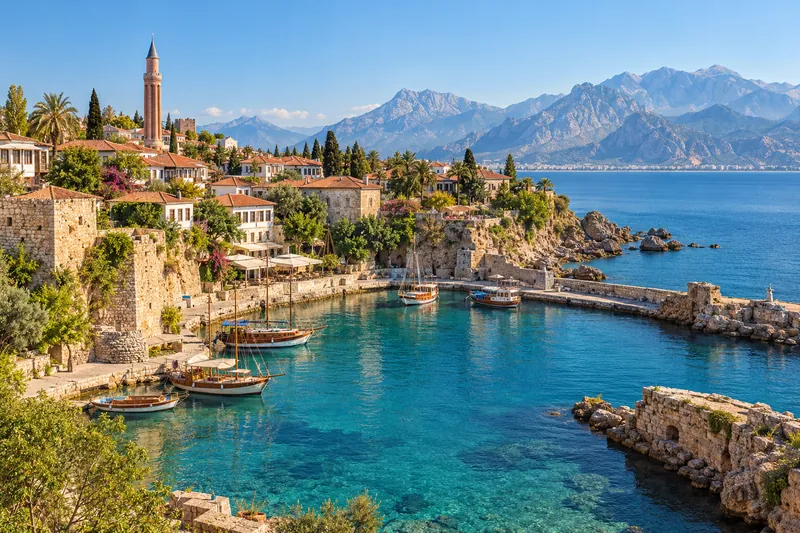
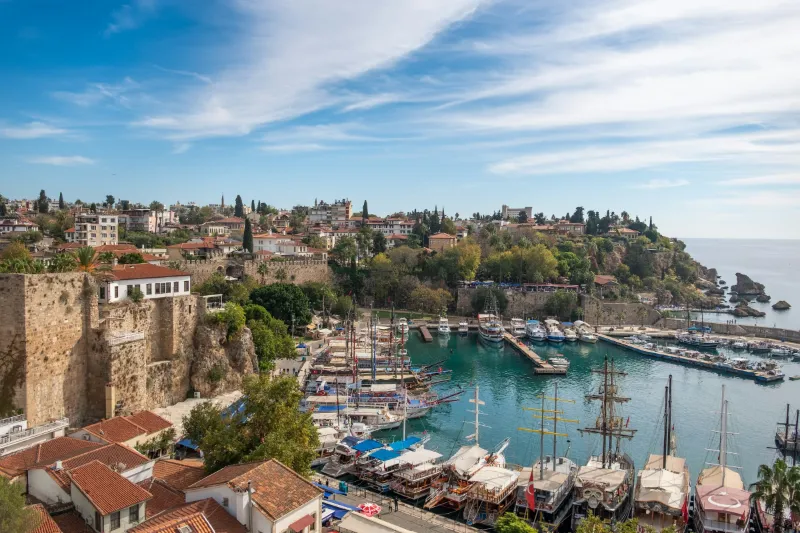
Kaleiçi ("inside the castle") is the walled old town, a maze of lanes with restored Ottoman wooden houses, small hotels and garden restaurants. The lanes run downhill to the old harbor, used since antiquity and now full of fishing boats and excursion boats. Look for the fluted Yivli Minaret, a 13th-century Seljuk landmark, and the Hıdırlık Tower, a round Roman tower above the cliffs with views across the bay to the mountains. Allow two to three hours, ideally in the late afternoon.
Hadrian's Gate
Hadrian's Gate is a triple-arched marble gateway built in AD 130 to mark the visit of the Roman emperor Hadrian. Locals call it Üçkapılar, "Three Gates." Look up at the coffered ceilings, carved with flowers and fruit, and at the lion heads along the cornice. The southern tower is Roman, while the upper part of the northern tower dates from the Seljuk period. The gate was hidden inside the city walls for centuries and uncovered in 1882. It is free, open-air and lit at night.
Antalya Museum (closed for rebuilding)
The Antalya Archaeological Museum, long one of the strongest regional museums in Turkey, has been closed since July 16, 2025. A seismic assessment rated the building high-risk, and the Ministry of Culture and Tourism is replacing it with a new building on the same site. Officials have stated a target of late 2026, and the Ministry's site still lists it as closed as of October 2026. The collection, including the statues from Perge, is in storage in Antalya. If you travel in 2027, ask us for the current status before you go.
Düden and Kurşunlu waterfalls
Antalya has two easy waterfall stops. The Upper Düden Falls sit in a shaded park about 7 miles (11 km) northeast of the center, where a path leads behind the curtain of water. The Lower Düden Falls drop straight off the cliffs into the sea near Lara, best seen from the clifftop park or from a boat out of the old harbor. Kurşunlu Falls, east of the city toward Aksu, lie in a small nature park with a looping trail through woods and pools. Each needs 45 minutes to an hour and makes a cool break between ruins.
Aspendos theater
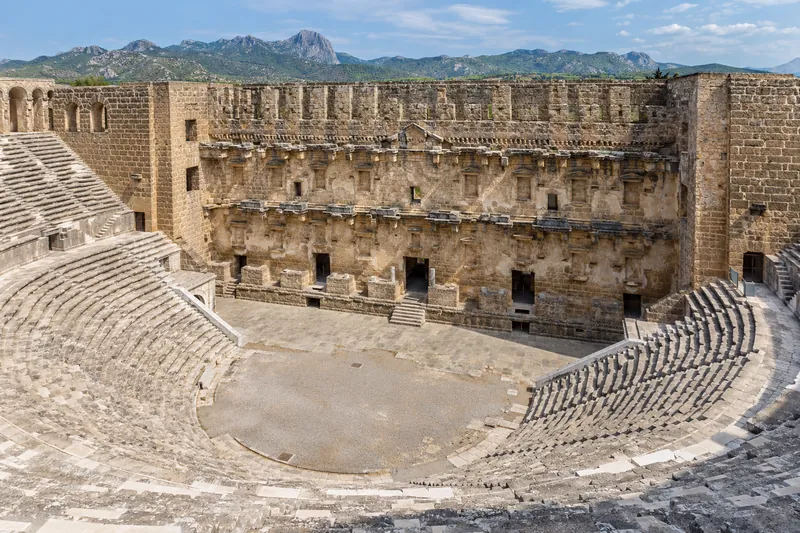
Aspendos has one of the best-preserved Roman theaters anywhere, still complete with its tall stage building. It was built around AD 155 by Zenon, an architect from Aspendos itself. Estimates of its capacity vary: around 7,000 seats is the conservative figure, while modern events have packed in far more. The acoustics are remarkable, and the theater still hosts the annual Aspendos Opera and Ballet Festival. Climb to the upper gallery for the full view, then drive a few minutes to see the arches of the Roman aqueduct across the plain. Allow about one hour.
Perge
Perge was a major city of Pamphylia, and its layout is easy to read. You enter past two round Hellenistic towers and walk up a long colonnaded street with a channel down the middle that once carried running water from the hills. Along the way are the agora, large Roman baths and a stadium. Note that the Ministry lists Perge's theater as temporarily closed for restoration, so you see it from outside. Allow 1.5 to 2 hours, and come early: the site is open and shadeless.
Side and the Temple of Apollo
Side is a seaside town built on top of an ancient port. You walk through a Roman gate, past a large theater and along the old main street to the Temple of Apollo, whose re-erected columns stand on the shore at the tip of the peninsula. Sunset there is the classic photo. A neighboring temple of Athena has also been restored in recent years. The small Side Museum, set in a Roman bath, holds statues from the town. Side is busy in summer, so pair it with Aspendos and reach the temple late in the day.
Termessos
Termessos is a mountain city at about 3,300 feet (1,000 m) inside Güllük Dağı-Termessos National Park. Alexander the Great surrounded it in 333 BC and chose not to attack, calling it an eagle's nest. The reward is the theater, perched on the edge of a drop with views over the plain toward the sea, plus tombs scattered among the pines. Expect a steep, rocky uphill walk of 20 to 30 minutes from the parking area. It suits sure-footed visitors and needs half a day.
Beaches: Konyaaltı and Lara
Konyaaltı Beach runs west of the center for several miles, with pebbles, clear water and mountain views, and a seafront park with cafés behind it. Lara Beach, east of the city, is sandy, with a long strip of large resort hotels. Both are easy taxi rides from Kaleiçi.
Antalya in the Bible: Perge and Attalia
For faith travelers, this coast is on Paul's first missionary journey. Paul and Barnabas sailed from Paphos on Cyprus to Perga in Pamphylia, where John Mark left them and returned to Jerusalem (Acts 13:13–14). On their way back they preached in Perga, then went down to Attalia, today's Antalya, and sailed for Antioch (Acts 14:24–26). Your guide can read the passages with you at Perge and the old harbor.
Tickets and opening hours (as of October 2026)
Prices for foreign visitors are set in euros and charged in Turkish lira at the daily rate. MüzeKart is for Turkish citizens only. Many Ministry sites switch to shorter winter hours in autumn, so check muze.gov.tr the week you travel.
| Site |
Ticket for foreign visitors |
Hours |
Notes |
| Aspendos Ancient Theater |
€15 |
08:00–19:00, ticket office closes 18:30 |
Open daily, audio guide available |
| Perge Archaeological Site |
€11 |
08:00–19:00, ticket office closes 18:30 |
Theater closed for restoration |
| Side Archaeological Site (theater area) |
€10 |
08:00–19:00; evening opening 19:00–22:00 |
Temple of Apollo on the shore is open-air |
| Termessos |
€3 |
08:00–17:00 |
A separate national park fee may apply |
| Antalya Museum |
Closed |
Closed |
Rebuilding; target reopening late 2026 |
| Hadrian's Gate |
Free |
Open-air |
Lit at night |
| Kaleiçi and the old harbor |
Free |
Open-air |
Shops and restaurants keep their own hours |
| Upper Düden Falls |
|
|
Municipal park |
| Kurşunlu Falls |
|
|
Nature park, small fee |
Passes: The Museum Pass The Mediterranean is listed at €90 for 7 days and covers more than 40 sites in the region, including Aspendos, Perge and Side. A new national tariff takes effect on April 1, 2027, so prices will rise next spring.
Best time to visit
May, June, September and October are the sweet spot: warm sea, long days and heat you can manage at the ruins. July and August bring highs in the mid-90s°F (about 35–36°C), so sightsee at opening time and swim in the afternoon. The main swim season runs from late May to mid-October.
| Months |
Weather |
Sea |
Crowds |
Notes |
| March–April |
Mild, 66–72°F (19–22°C) highs, some rain |
Cool, about 63–66°F (17–19°C) |
Light |
Good for ruins, too cool for most swimmers |
| May–June |
Warm to hot, 81–90°F (27–32°C) |
70–77°F (21–25°C) |
Rising |
A strong all-round choice |
| July–August |
Hot, about 97°F (36°C) |
81–82°F (27–28°C) |
Peak |
Ruins early, beach later |
| September–October |
Warm, 81–90°F (27–32°C) easing |
73–81°F (23–27°C) |
Moderate |
Warmest sea, softer light |
| November–February |
Mild, 61–68°F (16–20°C), wet spells |
63–68°F (17–20°C) |
Light |
Quiet, shorter site hours |
Guide's tip
Do Perge first thing in the morning, while it is still cool, then Aspendos before noon, and finish at Side for the late-afternoon light on the Temple of Apollo. All three sit along the same road east of the city, so with a private vehicle you never backtrack, and you are back in Antalya for dinner.
Practical tips
- Shoes: Wear closed shoes with grip. Kaleiçi lanes are steep and polished, and Termessos is rough mountain path.
- Heat: Perge and Aspendos have almost no shade. Carry water, a hat and sunscreen from May to October.
- Swimwear: Swimwear is fine on beaches and at hotels. Cover up with a shirt and shorts when you walk into town.
- Dress code: In mosques, cover shoulders and knees. Women need a headscarf.
- Cash: Ticket desks take cards. Carry some lira for waterfall parks, parking, small cafés and tips.
- Tipping: For a private guide and driver, tips are customary and appreciated. Your guide can advise on local norms.
- Accessibility: Hadrian's Gate, the Side seafront and the Upper Düden park are fairly easy. Aspendos involves steep stone steps; Perge is long and uneven; Termessos is not suitable for limited mobility.
From our guides' blog
Sources
FAQ
Is Antalya worth visiting on a Turkey tour?
Yes, if you have 10 days or more. Antalya adds what the inland route lacks: a warm sea, a walkable old town and several Roman sites in one area, including the Aspendos theater. It also breaks the long drive between Pamukkale and Cappadocia. On shorter trips, Istanbul, Cappadocia and Ephesus usually come first.
How many days do you need in Antalya?
Two full days cover Kaleiçi, the waterfalls, Perge and Aspendos, with Side if you start early. Three nights let you add Termessos or a true rest day at the beach. On our 14-day grand tour, Antalya has two nights, including a free day, followed by Aspendos on the way to Konya.
Is the Antalya Archaeological Museum open?
No. The museum closed on July 16, 2025, after its building was rated high-risk for earthquakes, and a new museum is being built on the same site. Officials have targeted late 2026 for completion, but the Ministry still lists it as closed as of October 2026. Check its status shortly before you travel.
Is the Aspendos theater worth seeing?
Yes. Aspendos is one of the most complete Roman theaters in the world, with its seating and tall stage wall still standing almost intact. It was built around AD 155 and still hosts performances. A visit takes about an hour, and it sits on the road between Antalya and Side or Konya.
When is the sea warm enough to swim in Antalya?
The main swim season runs from late May to mid-October. The sea is usually around 77–82°F (25–28°C) from June to September and stays near 73–75°F (23–24°C) in October. April and November are possible for a brisk dip, but most visitors find the water cool.
Did Saint Paul visit Antalya?
Yes. Acts 14:25 says Paul and Barnabas preached in Perga and then went down to Attalia, the ancient name of Antalya, before sailing to Antioch. Earlier, Acts 13:13 records their arrival at Perga from Cyprus. Faith travelers can visit Perge's ruins and Antalya's old harbor on the same day.
Which is better, Konyaaltı or Lara Beach?
Konyaaltı is pebbly, with clear water, mountain views and a long seafront park close to the old town. Lara is sandy and lined with large resort hotels further east. For a swim during a sightseeing stay in Kaleiçi, Konyaaltı is more convenient. For a sandy beach day, Lara suits better.
How do you get to Antalya?
Antalya sits on the Gulf of Antalya on Turkey's southern coast, backed by the Taurus Mountains. Most travelers arrive by road on a touring loop or fly into Antalya Airport (AYT), about 8 miles (13 km) east of the center. From Istanbul: about 1 hour 15 minutes by air, with many daily flights.
Which private tours include Antalya?
Our 14-day private tour includes Antalya. You will find it at the top of this page, with the full itinerary and prices.