Mardin at a glance
| Where | Southeast Turkey, an old town on a limestone ridge above the Mesopotamian plain |
|---|
| Getting there | Mardin Airport (MQM), about 20 km (12 miles) away, or by road from Şanlıurfa |
|---|
| Time needed | 2 nights |
|---|
| Best time to visit | April to May and late September to early November |
|---|
| Our private tours | 2 of our private tours include Mardin, starting from 6 days |
|---|
Summarize this guide with an AI assistant
Where is Mardin and how do you get there?
Mardin is the capital of Mardin Province in southeastern Turkey. The old town climbs the south face of a limestone ridge below a citadel, with the plain stretching toward Syria below. Most travelers fly in, or arrive by road from Şanlıurfa or Diyarbakır.
- Mardin Airport (MQM): near Kızıltepe, about 20 km (12 miles) from the city. Turkish Airlines, AJet and Pegasus connect it with Istanbul.
- By road: Mardin is usually reached from Şanlıurfa as part of a regional loop with Göbekli Tepe, Gaziantep and Mount Nemrut. Midyat is about 59 km (37 miles) east, roughly 1 hour 15 minutes by car.
In the old town, vehicles stay on the main street (1. Cadde); everything else is reached on foot by stepped lanes.
How much time do you need?
Give Mardin 2 nights. One full day covers the old town, the Great Mosque, the two madrasas and both museums. A second day can take in Deyrulzafaran in the morning and Dara in the afternoon, or a longer trip east to Midyat and Mor Gabriel.
To add Hasankeyf, plan a third night. The old town is best early and late in the day, when the stone glows in low sun.
What to see in and around Mardin
The old town and its stone houses
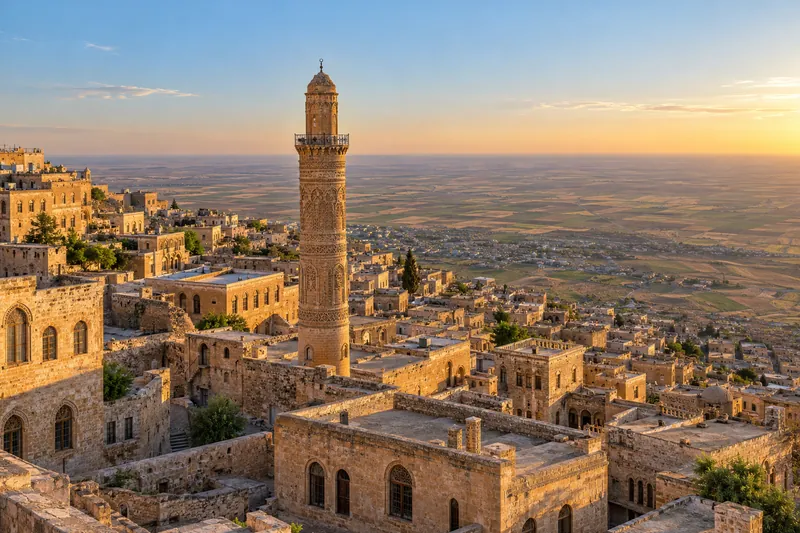
Mardin's old town is built in tiers down the hillside, so the flat roof of one house often forms the terrace of the one above. The houses are made of a soft local limestone that is easy to carve when freshly quarried and hardens with exposure, which is why doorways, window frames and balconies carry so much fine stonework. Walk the bazaar lanes off the main street, where coppersmiths and soap sellers still trade. The citadel at the top of the ridge is occupied by a military radar station and is not open to visitors, but you see it from almost everywhere. In February 2000, Turkey placed Mardin and its cultural landscape on its UNESCO World Heritage Tentative List.
Great Mosque (Ulu Camii)
The Great Mosque sits below the main street in the bazaar quarter and is the oldest major mosque in the city. It dates to the Artuqid period, the Turkmen dynasty that ruled Mardin from the 12th to the early 15th century. Its fluted minaret is the landmark you will spot in old town photos, and its inscription is dated 1176 and credits the Artuqid ruler Kutbettin Ilgazi II. It is an active mosque, so visit outside prayer times, remove your shoes inside, and women should cover their hair.
Zinciriye (Sultan İsa) Madrasa
Built in 1385 by the Artuqid ruler Melik Necmettin İsa, the Zinciriye Madrasa stands high on the slope above the main street. It has two floors arranged around two courtyards, a carved monumental entrance and ribbed domes, and it contains the tomb of Sultan İsa. Climb to the roof terrace for one of the widest views over the old town and the plain. Entry is free.
Kasımiye Madrasa
The Kasımiye Madrasa lies just outside the old town to the southwest, on a lower terrace. Work began under the Artuqids and was completed in the 15th century under the Akkoyunlu dynasty; dates given range from 1469 to the period 1487–1502 depending on the source. It combines a two-story madrasa, a mosque and a tomb. The highlight is the courtyard, where a channel carries water from the main iwan (open hall) to a central pool. It is quieter than the old town sites and worth a short drive.
Mardin Museum
The Mardin Museum occupies the former Syriac Catholic Patriarchate, a carved stone building from 1895, next to the Church of the Virgin Mary. The Ministry of Culture and Tourism restored it and opened it as a museum in 2000. Its collections cover the region's archaeology from prehistory onward, and the building itself, with arched porticos and terraces over the plain, is as much of a draw as the displays. Allow about an hour.
Sakıp Sabancı Mardin City Museum
This museum opened in 2009 in a restored 19th-century army barracks on the main square, created by the Sabancı Foundation. It focuses on everyday life in Mardin: crafts, trade, clothing, food and the city's mix of Muslim, Syriac Christian, Armenian and other communities, presented with dioramas and objects. The lower floor hosts the Dilek Sabancı Art Gallery for temporary exhibitions. Allow 45 to 60 minutes.
Deyrulzafaran Monastery (Mor Hananyo)
Deyrulzafaran is a Syriac Orthodox monastery about 3 to 5 km east of Mardin, on a hillside of yellow stone that gives it the "saffron monastery" name. The monastery was established in the late 5th century. It served as the seat of the Syriac Orthodox Patriarchate for centuries, until the early 20th century. It is still an active monastery with resident clergy, and services are held in Classical Syriac. Visits are by guided tour of the main church, the underground chamber and the tombs of patriarchs. Dress modestly and allow about an hour.
Dara ancient city
Dara lies in the village of Oğuz, about 30 km (19 miles) southeast of Mardin. The Byzantine emperor Anastasius I founded it around 505 AD as a fortress city on the frontier with the Sasanian Persian empire, and Justinian I later strengthened its walls and water system. Today you walk among rock-cut houses, a large necropolis cut into the hillside, and huge underground cisterns, one of which is a vaulted space well over 10 meters high. Excavations are ongoing. Your guide will confirm current opening times before you go. Allow 1.5 hours.
Midyat and Mor Gabriel Monastery (Tur Abdin)
East of Mardin is Tur Abdin, the historic heartland of Syriac Christianity. Midyat, about 59 km from Mardin, has an old town of large carved sandstone houses, church bell towers and filigree silver shops. Mor Gabriel Monastery, about 20 km east of Midyat, was founded in 397 AD and is one of the oldest Christian monasteries still in use anywhere. It is the seat of a Syriac Orthodox metropolitan bishop, and monks and students live there. Opening times are limited and can change for services, so plan a half day for Midyat and Mor Gabriel together.
Hasankeyf
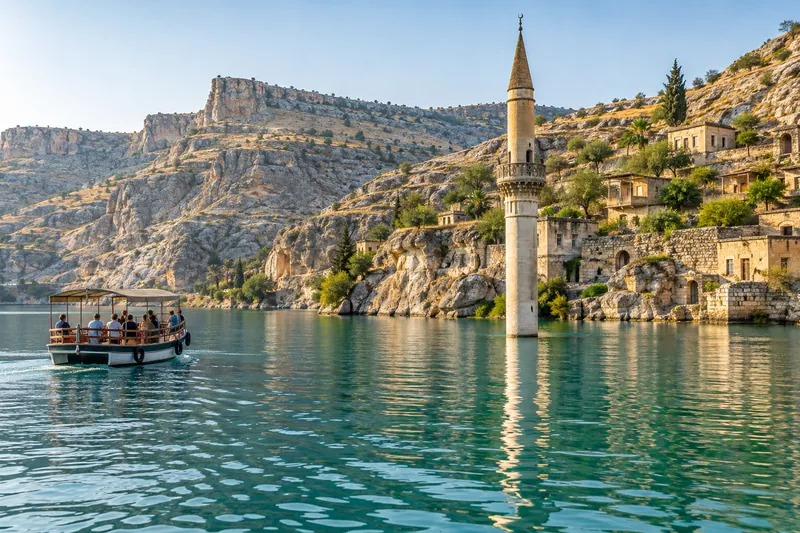
Hasankeyf, in Batman Province about 39 km (24 miles) north of Midyat, was a medieval town on the Tigris River that was submerged by the reservoir of the Ilısu Dam in 2020. Several monuments were moved before the flooding, including the 15th-century Zeynel Bey Tomb, which now stands in a cultural park near New Hasankeyf. A large new Hasankeyf Museum, which opened around 2021, displays finds from the excavations carried out before the dam. It works best as a stop on the way from Midyat to Batman or Diyarbakır.
Tickets and opening hours (as of October 2026)
We could not confirm current foreign-visitor prices from the Ministry's ticketing site for these sites. Figures below come from the sources listed and must be checked before publishing.
| Site |
Ticket for foreign visitors |
Hours |
Notes |
| Mardin Museum |
90 TL |
Oct–Mar 08:00–17:00; Apr–Sep 08:30–17:30; closed Mondays |
Ministry museum |
| Sakıp Sabancı Mardin City Museum |
|
Tue–Sun 08:00–17:00; closed Mondays |
Private foundation museum |
| Zinciriye Madrasa |
Free |
Daytime |
Roof terrace views |
| Kasımiye Madrasa |
Free |
Daytime |
Short drive from old town |
| Great Mosque |
Free |
Closed to visitors at prayer times |
Active mosque |
| Deyrulzafaran Monastery |
100 TL in 2024; current price |
Daily |
Guided visit; modest dress |
| Dara ancient city |
Free |
08:00–17:00, closed Mondays |
Exposed site |
| Mor Gabriel Monastery |
|
Limited daily hours |
Closed during services |
| Hasankeyf Museum |
|
|
Ministry museum |
Passes: The Museum Pass Türkiye covers Ministry museums. The Sabancı museum and the monasteries are not Ministry sites and charge separately or ask for a donation.
Best time to visit
Spring (April to May) and fall (late September to early November) are the most comfortable. Summer is hot: average July highs are about 36°C (97°F). Winter is cold for the region, with January highs around 7°C (44°F) and occasional snow.
| Months |
Weather |
Crowds |
Notes |
| December–February |
Cold, wet, occasional snow |
Low |
Quiet, but stone lanes can be slippery |
| March–May |
Mild, green plain in spring |
Moderate, busier on Turkish holidays |
Good for walking and views |
| June–August |
Very hot and dry |
Moderate |
Sightsee early and late; rest midday |
| September–November |
Warm, then mild and dry |
Moderate |
Comfortable; clear evening light |
Guide's tip
Climb to the roof of the Zinciriye Madrasa in the last hour before sunset, then walk down through the bazaar to dinner. The light on the plain changes quickly, and the lanes are cooler and livelier in the evening than in the middle of the day.
Practical tips
- Shoes and mobility: The old town is a steep slope of worn stone steps. Wear shoes with good grip. Travelers with limited mobility can be dropped at points along the main street to reduce climbing.
- Dress: Cover shoulders and knees for mosques and monasteries. Women should carry a scarf for mosques.
- Monastery etiquette: Deyrulzafaran and Mor Gabriel are working religious communities. Keep voices low, follow your guide, and ask before photographing clergy.
- Heat: From June to early September, start at 8 a.m., carry water and plan indoor visits for the afternoon. Dara has almost no shade.
- Cash: Carry Turkish lira for small shops, tea and monastery donations. Cards work in hotels and most restaurants.
- Shopping: Look for handmade soap, filigree silver in Midyat, and Syriac wine sold in some shops in Mardin and Midyat.
- Photography: Fine in the old town and at the sites. Do not photograph military installations, including the citadel area.
- Tipping: For a private guide and driver, a tip at the end of the trip is customary but not required.
Sources
- Mardin, Ministry of Culture and Tourism
- Dara Antik Kenti, Mardin Provincial Directorate of Culture and Tourism
- Mardin Museum, Turkish Museums (Ministry of Culture and Tourism)
- Madrasahs, Mardin Artuklu University
- Sakıp Sabancı Mardin Kent Müzesi, Cornucopia
- Mardin, Wikipedia
- Mardin Airport, Wikipedia
- Mor Hananyo Monastery (Deyrulzafaran), Wikipedia
- Dara (Mesopotamia), Wikipedia
- Dara Antik Kenti, Kure Ansiklopedi
- Dara Ancient City, Museum of Wander
- Midyat, Turkey Travel Planner
- Mor Gabriel Monastery, Audiala
- Hasankeyf, Wikipedia
- Hasankeyf Museum opening report, NTV
FAQ
Is Mardin worth visiting?
Yes, if you like historic towns, architecture and religious history. Mardin's carved stone houses, Artuqid madrasas and view over the Mesopotamian plain are unlike anywhere in western Turkey, and nearby Syriac monasteries such as Deyrulzafaran and Mor Gabriel are still active today.
How many days do you need in Mardin?
Plan 2 nights. That gives one day for the old town, the Great Mosque, the Zinciriye and Kasımiye madrasas and the two museums, and a second for Deyrulzafaran and Dara or for Midyat and Mor Gabriel. Add a night if you also want to see Hasankeyf and its new museum.
How do I get to Mardin from Istanbul?
Fly from Istanbul to Mardin Airport (MQM), served by Turkish Airlines, AJet and Pegasus. The airport is about 20 km (12 miles) from the city, a short drive by car or taxi. Many travelers instead arrive by road from Şanlıurfa as part of a loop with Göbekli Tepe and Mount Nemrut.
Can you visit Deyrulzafaran Monastery?
Yes. Deyrulzafaran, a working Syriac Orthodox monastery a few kilometers east of Mardin, is open to visitors, usually on a guided walk through the church, underground chamber and patriarchs' tombs. Dress modestly with shoulders and knees covered, and allow about an hour. There is a small entry fee, so check the current amount locally.
What is Mor Gabriel Monastery?
Mor Gabriel is a Syriac Orthodox monastery about 20 km east of Midyat, founded in 397 AD. It is one of the oldest Christian monasteries still in use and the seat of a metropolitan bishop for the Tur Abdin region. Visiting hours are limited and can change around services, so confirm times before you set out.
Can you still visit Hasankeyf?
Old Hasankeyf was submerged by the Ilısu Dam reservoir in 2020, so the historic town itself cannot be visited. You can see several relocated monuments, including the Zeynel Bey Tomb, in the cultural park at New Hasankeyf, visit the new Hasankeyf Museum with finds from pre-dam excavations, and take a boat on the reservoir.
When is the best time to visit Mardin?
Spring (April to May) and fall (late September to early November) are the most comfortable. Summer is hot: average July highs are about 36°C (97°F).
Which private tours include Mardin?
Several of our private tours include Mardin, starting from 6 days. They are listed at the top of this page with routes and prices per person.