Konya at a glance
| Where | South-central Turkey, between Cappadocia and the Aegean coast |
|---|
| Getting there | By road from Cappadocia: 230 km (145 miles), about 3 hours |
|---|
| Time needed | 1 full day |
|---|
| Best time to visit | April to early June and September to October |
|---|
| Our private tours | 4 of our private tours include Konya, starting from 8 days |
|---|
Summarize this guide with an AI assistant
Where is Konya and how do you get there?
Konya sits in south-central Turkey, roughly halfway between Cappadocia and the Aegean coast. On a private tour you usually arrive by road from Cappadocia and continue west toward Pamukkale or south toward Antalya.
- From Cappadocia (Göreme): about 145 miles (230 km), roughly 3 hours by road. The route passes the Sultanhanı caravanserai, a natural stop.
- From Pamukkale: about 250 miles (400 km), around 5 hours by road. Many itineraries break this drive with lunch in a lake town along the way.
- From Istanbul: the high-speed train runs about 420 miles (670 km) in roughly 5 hours 45 minutes, and domestic flights to Konya Airport (KYA) take about 1 hour 15 minutes.
The historic core is compact. The Mevlana Museum, Alaeddin Hill and the two Seljuk madrasas are all within a short drive or tram ride of each other. Sille is about 5 miles (8 km) northwest of the center, and Çatalhöyük is near the town of Çumra, roughly 40 minutes southeast by car.
How much time do you need?
One full day covers the essentials: Rumi's tomb, Alaeddin Hill, the Karatay tile museum and Sille. Add half a day for Çatalhöyük. If your dates include a Saturday evening, an overnight lets you attend the weekly Sema ceremony.
What to see in Konya
Konya was the capital of the Seljuk Sultanate of Rum in the 12th and 13th centuries, and its best monuments date from that era. Here is what to prioritize.
Mevlana Museum (Rumi's tomb)
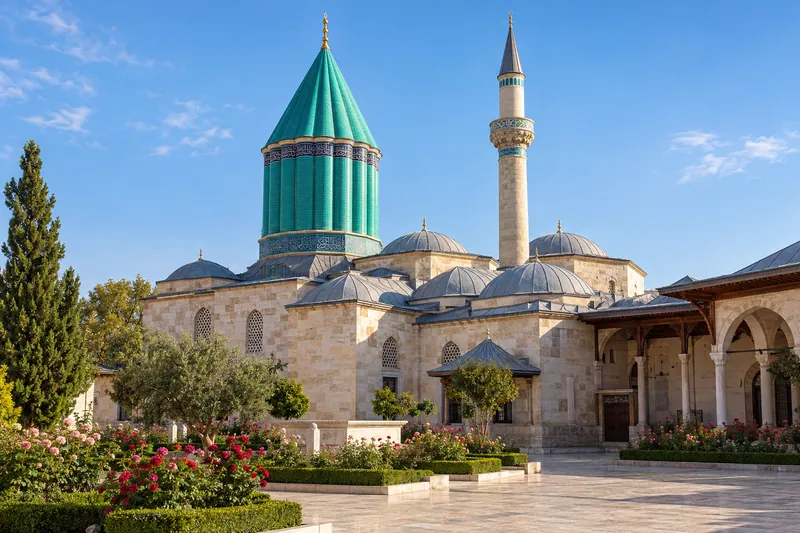
The Mevlana Museum is the former lodge of the Mevlevi order and holds the tomb of Jalal al-Din Rumi, the 13th-century Sufi poet who died in Konya in 1273. His tomb, built in 1274, sits under the green fluted dome that dominates the skyline. Inside, ornate cenotaphs of Rumi, his son Sultan Veled and other Mevlevi figures line the main hall. The adjoining ceremony hall (semahane) now displays musical instruments, robes, manuscripts and prayer rugs. The lodge closed in 1925 and reopened as a museum in 1926. Today it is both a museum and an active place of pilgrimage, so expect quiet prayer around the tomb. Entry is free. Plan about an hour.
The Whirling Dervish (Sema) ceremony
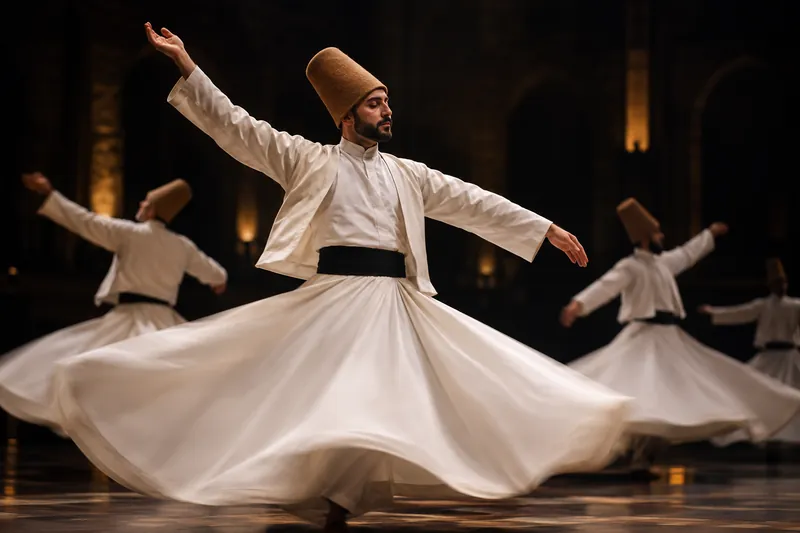
The Sema is the Mevlevi ritual of remembrance, in which semazens turn to music in a fixed sequence. UNESCO lists it as Intangible Cultural Heritage. In Konya, the Ministry of Culture and Tourism's Sufi music ensemble performs a Sema every Saturday evening at the Mevlana Cultural Center beside the museum, typically starting in the early evening. It is a religious ceremony, not a show, so no applause and no flash. The largest event is Şeb-i Arus, held each year from December 7 to 17 to mark the anniversary of Rumi's death on December 17. Tickets are sold online in advance and sell out early.
Alaeddin Hill and Alaeddin Mosque
Alaeddin Hill is a green, raised park in the city center, built on the ancient mound of Iconium. On top stands the Alaeddin Mosque, completed in 1220 and often described as the oldest surviving Seljuk mosque in Turkey. The prayer hall rests on about 42 columns reused from Roman and Byzantine buildings, and the carved ebony pulpit (minbar) dates to 1155. The courtyard holds a tomb where most of the Seljuk sultans are buried.
Karatay Madrasa (Tile Works Museum)
The Karatay Madrasa, built in 1251 by the Seljuk vizier Celaleddin Karatay, is now the Tile Works Museum. Step inside and look up: the central dome is covered in turquoise and dark blue tile mosaic arranged in star patterns, with an open oculus over a small pool. The collection includes Seljuk tiles from Kubadabad Palace on Lake Beyşehir, decorated with sphinxes, double-headed eagles, hunting scenes and court figures. It is small, so 30 to 40 minutes is enough, and it sits right at the foot of Alaeddin Hill.
İnce Minareli Madrasa
Across the hill from Karatay, the İnce Minareli ("slender minaret") Madrasa was built in the 1260s by the vizier Sahib Ata Fahreddin Ali, with an architect named Kölük whose name is carved above the door. Its tall carved stone portal, covered in interlaced Quranic inscriptions, is one of the finest in Anatolia. Lightning destroyed the upper minaret in 1901. The building has served as the Museum of Stone and Wood Works, with Seljuk reliefs of angels and double-headed eagles. A major restoration began in late 2024, so the interior may be closed. The portal can be seen from the street either way.
Sille village and the Church of St. Helena (Aya Elena)
Sille is a small stone village in a valley outside Konya, where Greek Orthodox and Muslim families lived side by side until the 1923–24 population exchange. Local tradition holds that the Church of St. Helena (Aya Elena) was founded in 327 by Helena, mother of Emperor Constantine, on her way to Jerusalem. The present building is much later, with painted interiors and a carved wooden iconostasis. After restoration it reopened as a museum in 2021. Sille also has rock-cut chapels in the cliffs above the village, a few cafés and craft shops, and makes a calm afternoon stop.
Çatalhöyük (UNESCO World Heritage Site)
Çatalhöyük is a Neolithic settlement about 40 minutes southeast of Konya, inscribed by UNESCO in 2012. Its east mound was occupied from around 7400 to 6200 BC, and houses were built wall to wall with entry through the roofs. Excavations found wall paintings, plastered bull horns and figurines, now mostly in the Museum of Anatolian Civilizations in Ankara. On site you see excavation areas under protective shelters, a visitor center and a replica house. Part of the site was temporarily closed at the time of writing. Allow about 1.5 hours plus driving time.
Sultanhanı and the Seljuk caravanserais
On the road from Konya to Cappadocia, the Sultanhanı caravanserai is the largest surviving Seljuk inn in Turkey. Sultan Alaeddin Keykubad I built it in 1229 to shelter traders on the caravan routes. The marble portal with carved honeycomb vaulting (muqarnas) leads to an open courtyard with a small raised mosque, and beyond it a vaulted winter hall lit by a central dome. Expect 30 to 45 minutes. Smaller caravanserais appear along the same road, and your guide can point them out as you drive.
Konya in the Bible: Iconium
Konya is the Iconium of the New Testament. Paul and Barnabas preached in the synagogue here on Paul's first missionary journey, and the city split between believers and opponents until a plot to stone them forced them to flee to Lystra and Derbe (Acts 14:1–7). They later returned to strengthen the church (Acts 14:21–22), and Timothy was well spoken of by believers in Iconium (Acts 16:2). Little from the Roman city survives above ground, but Christian travelers often read Acts 14 on Alaeddin Hill and visit Sille's church the same day.
Tickets and opening hours (as of October 2026)
The Mevlana Museum is free. Hours change seasonally, so check muze.gov.tr the week you travel. Children under 8 enter state museums free.
| Site |
Ticket for foreign visitors |
Hours |
Notes |
| Mevlana Museum |
Free |
09:00–17:00, ticket office closes 16:30 |
Open daily. On Mondays the office opens at 10:00 |
| Saturday Sema, Mevlana Cultural Center |
Free |
Saturday evening |
Arrive early for seats |
| Şeb-i Arus (Dec 7–17) |
Ticketed |
Evening ceremonies |
Sold online in advance |
| Karatay Tile Works Museum |
€3 |
Winter (Oct–Mar) 09:00–16:40; summer (Apr–Sep) 09:00–18:40 |
Price as listed on the Ministry portal |
| İnce Minareli Madrasa |
|
|
Under restoration since late 2024 |
| Alaeddin Mosque |
Free |
Outside prayer times |
Active mosque |
| Aya Elena Church, Sille |
|
|
Municipal museum |
| Çatalhöyük |
|
09:00–17:00, ticket office closes 16:40 |
Open daily. North area temporarily closed |
| Sultanhanı Caravanserai |
|
|
On the Konya–Aksaray road |
Passes: The Museum Pass Türkiye (€165, 15 days) covers state-run sites nationwide. In Konya alone, where the main site is free, it rarely pays off, but it can make sense across a full Turkey itinerary.
Best time to visit
April to early June and September to October are the most comfortable months. Konya sits at about 3,300 feet (1,000 m), so summers are hot and dry and winters are cold, sometimes with snow. December is cold but brings Şeb-i Arus.
| Months |
Weather |
Crowds |
Notes |
| March–May |
Mild to warm, cool nights |
Moderate |
Pleasant walking, green Alaeddin Hill |
| June–August |
Hot and dry, often 85–90°F (29–32°C) |
Moderate, Turkish pilgrims on weekends |
Sightsee early and late |
| September–October |
Warm days, cool evenings |
Moderate |
Strong all-round choice |
| November |
Cool to cold |
Light |
Quiet, shorter museum hours |
| December |
Cold, possible snow |
Very busy Dec 7–17 |
Şeb-i Arus; book hotels months ahead |
| January–February |
Cold, possible snow |
Light |
Bring warm layers |
Guide's tip
Visit the Mevlana Museum right at opening or around midday, when tour coaches thin out. If your tour reaches Konya on a Saturday, ask us to plan around the evening Sema at the cultural center; it is a short walk from the museum and gives the tomb visit real context.
Practical tips
- Dress code at Mevlana: Cover shoulders and knees, for men and women. Women should cover their hair in the tomb area. Scarves are available at the entrance, and you put plastic covers over your shoes.
- Behavior at the tomb: Many visitors are praying. Speak quietly and do not stand in front of people at prayer.
- Photography: Personal photos are generally allowed inside the museum without flash. Be discreet near worshippers. At the Sema, photography may be restricted, so follow staff instructions.
- Mosques: Remove shoes, and avoid visiting during Friday midday prayers.
- Food: Try etli ekmek (long flatbread with minced meat) and fırın kebabı (slow-roasted lamb), both local specialties.
- Cash: Carry some Turkish lira for Sille cafés, parking, small purchases and tips.
- Shoes: Çatalhöyük and Sultanhanı involve gravel and uneven stone. Wear closed shoes.
- Accessibility: The Mevlana Museum is largely on one level. Alaeddin Hill has slopes and steps, and Sille's rock chapels require climbing.
Common myths about Konya
- Myth: The whirling dervish ceremony is a dance show. Fact: The Sema is a religious ceremony of the Mevlevi order. UNESCO lists the Mevlevi Sema ceremony as intangible cultural heritage.
From our guides' blog
Sources
FAQ
Is Konya worth visiting?
Yes, especially if you are driving between Cappadocia and Pamukkale. Konya holds Rumi's tomb, some of the finest Seljuk architecture in Turkey and, nearby, the Neolithic site of Çatalhöyük. It also breaks a long drive into two comfortable days. Travelers interested in Sufism, Islamic art or the Book of Acts usually find it rewarding.
How long should I spend in Konya?
One night and a full day are enough for most travelers. That covers the Mevlana Museum, Alaeddin Hill, the Karatay tile museum and Sille. Add half a day for Çatalhöyük. If you want to see the weekly Sema ceremony, plan your overnight to include a Saturday evening.
Where can I see the whirling dervishes in Konya?
The main venue is the Mevlana Cultural Center, next to the Mevlana Museum. A Ministry of Culture and Tourism ensemble performs the Sema there every Saturday evening year round. During Şeb-i Arus, December 7 to 17, there are daily ceremonies. Confirm the start time locally, since it can shift between seasons.
When is the Şeb-i Arus festival?
Şeb-i Arus runs each year from December 7 to 17 in Konya, ending on the anniversary of Rumi's death on December 17, 1273. The name means "wedding night," reflecting Rumi's view of death as reunion with God. Ceremonies are held at the Mevlana Cultural Center. Buy tickets online early and book hotels months ahead.
What should I wear to the Mevlana Museum?
Cover your shoulders and knees, whether you are a man or a woman. Women should also cover their hair in the tomb area, and scarves are provided at the entrance if needed. Staff give you plastic covers to wear over your shoes. Long, loose clothing is the simplest choice.
Is Konya the biblical Iconium?
Yes. Konya stands on the site of ancient Iconium, where Paul and Barnabas preached during the first missionary journey (Acts 14). Opposition forced them to flee to Lystra and Derbe, but they later returned to encourage the believers. Few Roman remains survive, but Alaeddin Hill marks the ancient city mound.
Is Çatalhöyük worth the detour from Konya?
For travelers interested in archaeology, yes. Çatalhöyük is one of the earliest large settlements known, occupied from about 7400 BC, and a UNESCO World Heritage Site. The visible remains are modest earth walls under shelters, so it suits curious visitors more than those expecting grand ruins. It adds about half a day.
How do you get to Konya?
Konya sits in south-central Turkey, roughly halfway between Cappadocia and the Aegean coast. On a private tour you usually arrive by road from Cappadocia and continue west toward Pamukkale or south toward Antalya. From Cappadocia (Göreme): about 145 miles (230 km), roughly 3 hours by road.
Which private tours include Konya?
Several of our private tours include Konya, starting from 8 days. They are listed at the top of this page with routes and prices per person.