Mount Nemrut at a glance
| Where | Kahta district, Adıyaman province, in the Eastern Taurus mountains |
|---|
| Getting there | By road from Kahta: 52 km (32 miles), about 1 to 1.5 hours |
|---|
| Time needed | 1.5 to 2 hours on the summit |
|---|
| Best time to visit | Late May to early October |
|---|
| UNESCO World Heritage | Nemrut Dağ (1987) |
|---|
| Our private tours | 2 of our private tours include Mount Nemrut, starting from 6 days |
|---|
Summarize this guide with an AI assistant
Where is Mount Nemrut and how do you get there?
Mount Nemrut is in the Kahta district of Adıyaman province, in the Eastern Taurus mountains of southeastern Turkey. Most visitors approach from the south, through the town of Kahta, and drive the last stretch up a mountain road to a car park below the summit.
- From Kahta (south side): about 52 km (32 miles), roughly 1 to 1.5 hours by road. The village of Karadut, about 12 km (7.5 miles) below the summit, has small guesthouses that make a pre-dawn start easier.
- From Adıyaman city: about 84 km (52 miles), around 2 hours.
- From Malatya (north side): a separate road climbs from the Malatya side. The final walk from that side is shorter, but the drive is longer and the north side is less commonly used on regional itineraries.
- Airports: Adıyaman Airport is the closest, about 40 minutes from Kahta. Malatya and Gaziantep airports are alternatives with more flights. Many travelers arrive by road from Şanlıurfa or Gaziantep as part of a southeastern loop.
The road ends at a car park with a small facilities building. From there you walk the last part to the terraces: plan on about 500 to 600 m (roughly a third of a mile) of uphill path and steps, which takes 20 to 30 minutes at a steady pace.
How much time do you need?
Allow 1.5 to 2 hours on the summit, including the walk up and time on both the east and west terraces. With Arsameia, Cendere Bridge and Karakuş added, the area fills a full day, so plan one night in Kahta or Karadut.
A practical plan is to see the lower sites in the afternoon and finish at the summit for sunset, or reverse it: summit at sunrise, then the lower sites on the way back down. Trying to see Nemrut as a day trip from Şanlıurfa or Gaziantep means many hours in the car and missing the best light.
What to see at Mount Nemrut and nearby
The tumulus of Antiochus I
The summit is crowned by a man-made mound of loose stone chips, about 50 m (164 ft) high and 145 m (476 ft) across, according to UNESCO. It was raised by Antiochus I, king of Commagene, who reigned from 69 to 34 BC, as his tomb-sanctuary, a "hierothesion" or house of the gods. The mound was once taller; weather and visitors climbing it have worn it down.
Archaeologists believe Antiochus is buried under the mound, but his tomb chamber has never been found. The loose rock makes digging dangerous. A German engineer, Karl Sester, recorded the site in 1881, and the American archaeologist Theresa Goell led excavations from the 1950s. Visitors are not allowed to climb the mound.
The East Terrace
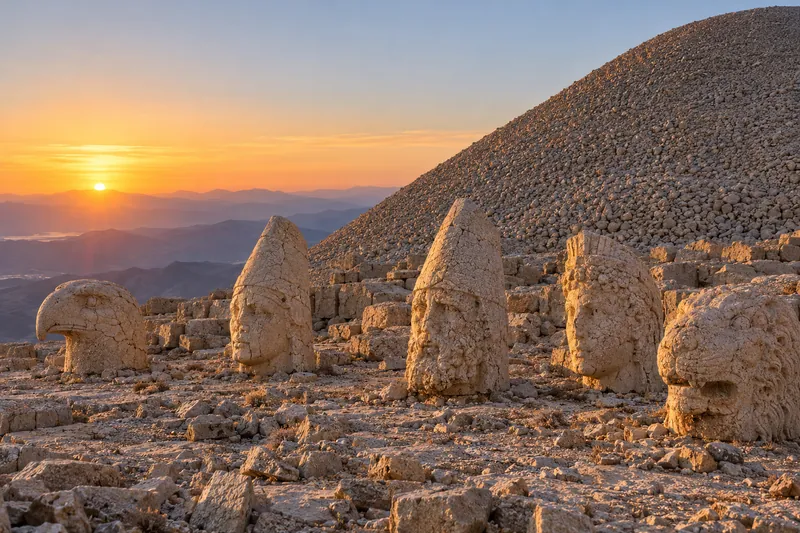
The East Terrace is where most people watch the sunrise. Five colossal seated statues once sat in a row here, with a lion and an eagle as guardians at each end. Inscriptions identify them as Antiochus himself, the goddess Commagene (a Tyche figure), and three gods that blend Greek and Persian deities: Zeus-Oromasdes, Apollo-Mithras-Helios-Hermes and Heracles-Artagnes-Ares.
The bodies still stand, but the heads fell long ago and now rest on the ground in front. Each head is taller than a person. Below them, rows of sandstone slabs show Antiochus's ancestors: Persian kings on his father's side and Macedonian rulers on his mother's side. A stepped altar platform faces the statues.
The West Terrace
The West Terrace repeats the same group of gods and guardians, but here the heads are better preserved and closer to eye level, which makes it the favorite for photos. This is where people gather at sunset.
The West Terrace also has relief slabs showing Antiochus shaking hands with the gods, a gesture called dexiosis, and the famous lion horoscope: a lion carved with stars and a crescent moon. Researchers have linked it to a planetary alignment in July 62 BC, possibly the date of Antiochus's coronation or the founding of the sanctuary, though not all scholars agree on the date.
The North Terrace
A third, smaller terrace on the north side connects the east and west terraces along the path around the mound. It has no colossal statues, and most visitors pass it on the walk between the two main terraces.
Arsameia (Eski Kahta)
Arsameia on the Nymphaios sits on a hillside near Eski Kahta, on the way up the mountain. It was the sanctuary of Antiochus's father, Mithridates I Callinicus, built by Antiochus. The highlight is a large relief of a Commagene king shaking hands with a naked Heracles holding his club, one of the best preserved in the region. Next to it is a long Greek inscription about the founding of the sanctuary and a rock-cut passage leading steeply into the hill. The walk is short but uneven. A recent Ministry tariff lists Arsameia as part of the Nemrut site.
Cendere Bridge
Cendere Bridge (the Severan Bridge) crosses the Cendere stream on the road between Kahta and the mountain. Built around AD 200, it honors Emperor Septimius Severus, his wife Julia Domna and their sons Caracalla and Geta. Three of the original four Corinthian columns still stand; Geta's was removed after his brother had him killed. Its single arch spans about 34 m (112 ft), one of the longest surviving Roman arch spans. It is closed to vehicles, so you can walk across.
Karakuş Tumulus
Karakuş is a smaller burial mound about 12 km (7.5 miles) from Kahta, built around 30 to 20 BC by Mithridates II of Commagene for royal women of the family. Groups of columns about 9 m (30 ft) tall surround the mound. One is still topped by an eagle, which gives the site its name: karakuş means "black bird." It takes about 20 minutes and makes an easy first or last stop.
Tickets and opening hours (as of October 2026)
We could not load the official Mount Nemrut page on muze.gov.tr. Figures below come from recent 2026 secondary sources and must be confirmed before publishing.
| Site |
Ticket for foreign visitors |
Hours |
Notes |
| Mount Nemrut summit (Nemrut Örenyeri) |
€10 |
Opens early for sunrise; 04:00 to evening reported |
Road closed in winter; Arsameia reported as part of the same site |
| Arsameia |
Included with Nemrut |
Daylight hours |
Uneven paths |
| Cendere Bridge |
Free |
Open access |
Roadside |
| Karakuş Tumulus |
Free |
Open access |
Roadside, near Kahta |
Passes and night program: The Museum Pass Türkiye is reported as valid at Nemrut. The MüzeKart is for Turkish citizens and residents. In summer 2026 Nemrut was part of the Ministry's night museum program (1 June to 1 October), which opened the site from 04:00 for sunrise. Check current hours for later in the season.
Best time to visit
Late May to early October is the most reliable window, with June to September the warmest. GoTürkiye lists the site as open from April to November. In winter, snow closes the road to the summit, often for four to five months, and drifts can be several meters deep.
| Months |
Weather at the summit |
Crowds |
Notes |
| December–March |
Snow and ice |
Very low |
Road usually closed |
| April–May |
Cold, snow patches possible |
Low |
Opening date depends on snow clearing |
| June–August |
Mild days, cold and windy at dawn |
Highest, especially at sunset |
Lower sites are hot by midday |
| September–November |
Clear skies, cold early and late |
Moderate to low |
Early fall is a good balance; late fall weather is changeable |
Even in July, temperatures at sunrise can be near freezing with a strong wind. Bring a warm jacket whatever the season.
Guide's tip
If you choose sunrise, start the walk up in the dark with a flashlight and go straight to the East Terrace, then cross to the West Terrace once the sun is up. The light reaches the western heads soon after, and most of the crowd has already headed back down to breakfast.
Practical tips
- Sunrise or sunset: Sunrise is at the East Terrace and means leaving Kahta or Karadut around 3:00 to 4:00 am in summer. Sunset is at the West Terrace and is easier on sleep, but busier.
- Warm clothing: Layers, a windproof jacket, a hat and gloves for sunrise, even in summer. The car park area is colder than you expect.
- Shoes: Wear sturdy shoes with grip. The path from the car park is steep in places, with steps and loose rock near the terraces.
- Altitude and fitness: At about 2,134 m (7,000 ft), the climb feels harder than its length. Walk slowly and rest on the way. Travelers with heart or breathing problems should ask their doctor before going.
- Accessibility: There is no step-free route to the terraces. Travelers using a wheelchair or with limited mobility can usually still enjoy Cendere Bridge and Karakuş from close to the road.
- Flashlight: Bring a headlamp or phone light for the dark walk before sunrise and the descent after sunset.
- Food and water: Facilities at the summit are basic. Eat in Kahta or at your guesthouse, and carry water and a snack.
- Respect the site: Do not climb the tumulus, sit on the heads or touch the reliefs. Stay on marked paths.
- Cash: Carry some Turkish lira for small purchases in villages. Cards are accepted in hotels and most restaurants in Kahta.
- Tipping: For a private guide and driver, a tip at the end of the trip is customary but not required.
Common myths about Mount Nemrut
- Myth: Mount Nemrut is the volcano near Lake Van. Fact: They are different mountains. The Mount Nemrut with the colossal statues is in Adıyaman province; Nemrut Caldera is a volcano near Lake Van in Bitlis province.
Sources
- Nemrut Dağ, UNESCO World Heritage Centre
- The UNESCO Sites of Türkiye: Nemrut, Ministry of Culture and Tourism (Turkish Museums)
- 2 Days on Mount Nemrut, GoTürkiye
- Gece Müzeciliği 2026, GZT
- 2027 museum and site fee tariff, Ministry schedule (alomaliye.com copy)
- Beyaz örtüyle kaplı Nemrut Dağı'nın yolu açılıyor, Milliyet
- Climbing Nemrut Dağı, Turkey Travel Planner
- How to Visit Mount Nemrut, The Mediterranean Traveller
- Nemrut Dağı Giriş Ücreti 2026, Gezipass (secondary source for current price)
- Nemrut Dağı, Rotasenin (secondary source for hours and walk)
- Mount Nemrut, Wikipedia
- Severan Bridge, Wikipedia
- Karakuş Tumulus, Wikipedia
- Arsameia, Wikipedia
FAQ
Is Mount Nemrut worth visiting?
Yes, if you are interested in ancient history or dramatic landscapes. The colossal heads of gods and a king on a remote summit are unlike anything else in Turkey, and the sunrise or sunset adds to the experience. It works best as part of a southeastern route with Göbekli Tepe and Mardin, since reaching it takes effort.
Should I see Mount Nemrut at sunrise or sunset?
Both are impressive. Sunrise is watched from the East Terrace and is usually quieter, but it means a 3:00 to 4:00 am start and freezing temperatures. Sunset is watched from the West Terrace, where the best-preserved heads are, and is easier to fit into a day, though it draws larger crowds in summer.
How do you get to Mount Nemrut?
Most travelers base themselves in Kahta, in Adıyaman province, and drive about 52 km (32 miles), roughly 1 to 1.5 hours, to a car park below the summit. Adıyaman Airport is the closest airport. From the car park, a walk of about 500 to 600 m uphill, taking 20 to 30 minutes, leads to the terraces.
How hard is the walk to the top of Mount Nemrut?
The walk from the car park is short, about 500 to 600 m, but steep, with steps and rocky sections near the terraces. At around 2,134 m (7,000 ft), the thin air makes it feel harder. Most reasonably fit travelers manage it in 20 to 30 minutes by walking slowly and taking short breaks.
When is Mount Nemrut open?
The summit road is usually open from about April to November, depending on snow. In winter it is typically closed for four to five months. Late May to early October is the most dependable period. Opening hours start very early in summer to allow sunrise visits, so check current hours before you go.
Who built Mount Nemrut?
Antiochus I, king of Commagene, who ruled from 69 to 34 BC, built the tomb-sanctuary as a monument to himself and the gods. The statues mix Greek and Persian deities, reflecting his Persian and Macedonian ancestry. UNESCO added the site to the World Heritage List in 1987.
How much time do you need for Mount Nemrut?
Allow 1.5 to 2 hours on the summit, including the walk up and time on both the east and west terraces. With Arsameia, Cendere Bridge and Karakuş added, the area fills a full day, so plan one night in Kahta or Karadut.
Is Mount Nemrut a UNESCO World Heritage Site?
Yes. It is on the UNESCO World Heritage List as “Nemrut Dağ”, inscribed in 1987.
Which private tours include Mount Nemrut?
Several of our private tours include Mount Nemrut, starting from 6 days. They are listed at the top of this page with routes and prices per person.