Pamukkale at a glance
| Where | A village in Denizli Province, inland southwest Turkey |
|---|
| Getting there | Denizli Çardak Airport (DNZ), with nonstop flights from Istanbul |
|---|
| Time needed | Half a day at least; a full day with the Antique Pool, the museum and Laodicea |
|---|
| Best time to visit | April to early June and September to October |
|---|
| UNESCO World Heritage | Hierapolis-Pamukkale (1988) |
|---|
| Our private tours | 12 of our private tours include Pamukkale, starting from 5 days |
|---|
Summarize this guide with an AI assistant
Where is Pamukkale and how do you get there?
Pamukkale is a small village in Denizli Province, in inland southwest Turkey. The terraces and Hierapolis sit on the ridge directly above the village, about 18 km (11 miles) north of Denizli's main bus terminal.
By air: Denizli Çardak Airport (DNZ) has nonstop flights from Istanbul on Turkish Airlines and Pegasus. The airport is about 64 km (40 miles) east of Denizli city, so allow roughly an hour or a little more by car to Pamukkale.
From Ephesus, Selçuk or Kuşadası: Most travelers arrive by road from the Ephesus area. The drive along the Büyük Menderes valley takes about three hours from Selçuk and a little longer from Kuşadası, with rest stops. Trains also run from Selçuk to Denizli in a little over three hours, but you then need a transfer up to the site.
From Cappadocia or Konya: This is a long road day, so many itineraries break it with a stop in Konya or fly via Istanbul.
On a private tour, your driver drops you at the South Gate and collects you at the North Gate, so you walk the site one way, downhill, without doubling back.
How much time do you need?
Plan at least half a day for the travertines and the main ruins of Hierapolis, and a full day if you want the Antique Pool, the museum and Laodicea at an easy pace.
A typical half day covers the theater, the main street, the travertine walk and a short look at the necropolis. That takes three to four hours with photo stops. Adding a swim in the Antique Pool, the Hierapolis Archaeology Museum and the Martyrium of St. Philip easily fills a day.
Most travelers stay one night in Pamukkale or nearby Karahayıt. That lets you visit early in the morning or late in the afternoon, when the light is softer, the white rock is less glaring and tour buses have thinned out.
What to see in Pamukkale
The travertine terraces
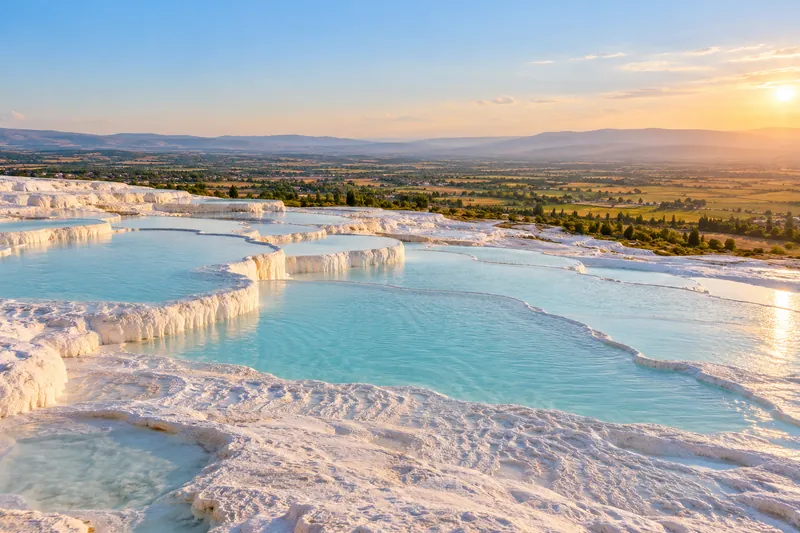
The terraces formed as mineral-rich thermal water flowed down a cliff about 200 meters high and left behind white calcium carbonate deposits. UNESCO describes the result as terraces, petrified waterfalls and basins. The Turkish name Pamukkale means "cotton castle."
Visitors walk a marked path down through the terraces, with shallow pools you can step into. Shoes are not allowed on the travertines. You walk barefoot or in socks to protect the rock surface, and guards enforce this. Many terraces are kept dry in rotation for conservation, so the water you see changes by season. Stay on the open path; walking on closed areas is not permitted.
Hierapolis ancient city
Hierapolis was founded by the Attalid kings of Pergamon in the late 2nd century BC and grew into a Roman spa city around its hot springs. UNESCO lists its thermal baths, theater, monumental arch, nymphaeum and a necropolis that stretches for about 2 km.
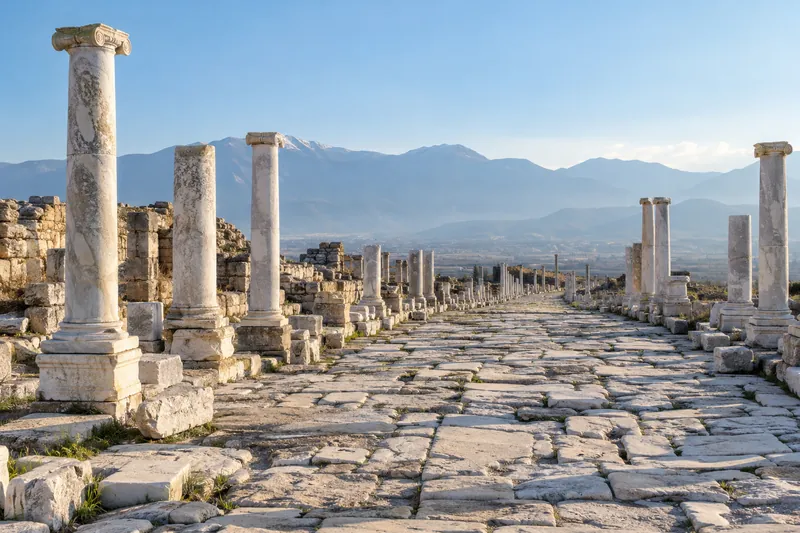
Highlights include the large Roman theater, restored with much of its stage building; the colonnaded main street running between the Frontinus Gate and the southern gate; and the Plutonium, a sanctuary built over a cave that releases carbon dioxide and was linked in antiquity to the underworld. The site is spread out, so comfortable shoes and water make a real difference.
Martyrium of St. Philip
On the hillside above the theater stands the Martyrium of St. Philip, an early Christian pilgrimage building associated with the apostle Philip. UNESCO highlights its octagonal plan as a notable piece of early Christian architecture.
The climb from the main street is steep in the heat, but you get wide views over the site and the valley. Excavations nearby have uncovered a church and tomb area connected to the Philip tradition. For travelers on faith-focused trips, this is often a key stop, and it pairs well with Laodicea on the same day.
The Antique Pool (Cleopatra Pool)
The Antique Pool is a thermal pool inside Hierapolis where you swim over fallen marble columns and architectural blocks. The water stays at about 36°C (97°F) year-round. Popular legend links it to Cleopatra, but there is no historical evidence for that.
It requires a separate ticket from the main site. The pool reopened on May 1, 2026, after renovation work that began in January 2025. Changing rooms and lockers are available. Bring a swimsuit and a towel, and expect it to be busy around midday in summer.
Hierapolis Archaeology Museum
The Hierapolis Archaeology Museum is housed in the former Roman baths beside the Antique Pool. It displays finds from Hierapolis and nearby sites, including sarcophagi, statues and carved reliefs from the theater.
The museum is compact, and 30 to 45 minutes is enough for most visitors. It is a good break from the sun in the middle of the day. Several recent visitor guides report that entry is included in the main Hierapolis-Pamukkale ticket, but confirm this at the gate.
Laodicea
Laodicea (Laodikeia) is a large Roman city about 12 km (7 miles) south of Pamukkale. It is one of the Seven Churches of Revelation, addressed in Revelation 3 as the "lukewarm" church.
Excavations have revealed colonnaded streets, theaters, temples, a large stadium and a 4th-century church. Restoration has made it much easier to understand than it was a decade ago. Laodicea has its own ticket and needs one and a half to two hours. It is quieter than Hierapolis, which many visitors appreciate.
Karahayıt red springs
Karahayıt is a spa village about 5 km north of Pamukkale. Its hot springs carry iron and other minerals that stain the deposits red, orange and green, a striking contrast with the white terraces.
There is a small public area with a spring-fed fountain and colored deposits, and many of the region's thermal hotels are here. A stop takes 15 to 30 minutes, and it fits easily on the way to or from your hotel.
Tickets and opening hours (as of October 2026)
The Ministry of Culture and Tourism prices foreign-visitor tickets for state sites in euros, charged in Turkish lira at the daily rate.
| Site |
Ticket for foreign visitors |
Hours |
Notes |
| Hierapolis-Pamukkale (travertines and ancient city) |
€30 |
Open daily from 08:00; closing later in summer than in winter |
Rising to €35 from April 1, 2027. Ticket sales stop about 30 minutes before closing. |
| Antique Pool (Cleopatra Pool) |
600 TL |
|
Separate ticket. Children under 6 free. Reopened May 1, 2026. |
| Hierapolis Archaeology Museum |
Reportedly included in the main ticket |
|
Housed in the Roman baths. |
| Laodicea |
€12 |
Summer about 08:00 to 21:00, winter about 08:00 to 17:30 |
Rising to €13 from April 1, 2027. |
| Karahayıt red springs |
Free public area |
Open access |
Hotels charge for their own thermal pools. |
Museum Pass Türkiye: The nationwide Museum Pass covers state sites such as Hierapolis and Laodicea but not the Antique Pool, which is run by a separate operator. Current pass price:.
Best time to visit
Short answer: April to early June and September to October. Summer is very hot on the exposed white rock, and winter is cool with shorter hours.
| Months |
Weather |
Crowds |
Notes |
| March |
Cool, some rain |
Low |
Travertines cold underfoot. |
| April to May |
Mild and pleasant |
Moderate |
Good for walking Hierapolis. |
| June |
Warm to hot |
Moderate to high |
Go early or late. |
| July to August |
Very hot, strong glare |
High |
Sunglasses, hat and water essential. Midday is hard on the feet and eyes. |
| September to October |
Warm, then mild |
Moderate to high |
Comfortable, good light. |
| November to February |
Cool to cold, occasional rain |
Low |
Shorter opening hours; pool still warm. |
Guide's tip
Enter at the South Gate, walk the colonnaded street and the theater first, and arrive at the travertines in the late afternoon. The rock is less blinding, the surface is cooler on bare feet, and the sun sets over the valley in front of you. Carry a small bag for your shoes and a quick-dry towel for the pools.
Practical tips
- Barefoot rule: Shoes are not allowed on the travertines. Bring a bag for your shoes and a small towel. Socks are allowed.
- Slippery spots: Wet travertine can be slick, and some areas are ridged and uncomfortable underfoot. Walk slowly and use the handrails where provided.
- Sun and glare: The white surface reflects strongly. Wear sunglasses, a hat and sunscreen, and carry water.
- Swimwear: Pack a swimsuit if you plan to use the Antique Pool or your hotel's thermal pool.
- Cash and cards: Cards are accepted at ticket offices. Keep some Turkish lira for cafés, lockers and tips.
- Tipping: Tips for guides and drivers are customary on private tours; around 5 to 10 percent is common in restaurants.
- Accessibility: Hierapolis is large and uneven, and the climb to the Martyrium is steep. The travertine path is downhill and wet. Tell us in advance about any mobility needs so we can plan drop-off points.
- Photography: Photos are fine throughout. Drones need permission and are generally not allowed at archaeological sites without it.
- Hot springs and health: If you have heart or blood pressure concerns, ask your doctor before soaking in hot thermal water.
Common myths about Pamukkale
- Myth: The white terraces are snow or salt. Fact: They are travertine: calcium carbonate left behind as warm, mineral-rich spring water cools and flows down the slope.
- Myth: You can walk anywhere on the terraces. Fact: Visitors may only walk on the marked path, and only barefoot, to protect the travertine.
From our guides' blog
Sources
FAQ
Is Pamukkale worth visiting?
Yes, for most travelers on a western Turkey route. You get a natural landmark and a large Roman city on the same ticket, and it sits conveniently between Ephesus and Cappadocia or Konya. Manage expectations about the water: many terraces are kept dry in rotation for conservation, so not every pool is full.
How long do you need at Pamukkale?
Plan half a day for the travertines and the main ruins of Hierapolis, about three to four hours. A full day lets you add the Antique Pool, the archaeology museum, the Martyrium of St. Philip and nearby Laodicea. Staying one night allows an early or late visit with fewer crowds.
Do you have to take your shoes off at Pamukkale?
Yes. Shoes are not allowed on the travertine terraces, to protect the rock surface. You walk barefoot or in socks along the marked path, and guards enforce the rule. Carry a small bag for your shoes. Some parts of the surface are ridged, so walk slowly.
How much does it cost to visit Pamukkale?
As of October 2026, foreign visitors pay €30, charged in Turkish lira, for the Hierapolis-Pamukkale ticket, which covers the travertines and the ancient city. The fee is set to rise to €35 from April 1, 2027. The Antique Pool requires a separate ticket, currently 600 Turkish lira for foreign visitors.
Can you swim in Cleopatra's Pool?
Yes. The Antique Pool, often called Cleopatra's Pool, is a thermal pool inside Hierapolis where you swim among fallen ancient columns. The water stays at about 36°C (97°F). It needs a separate ticket and reopened on May 1, 2026, after renovation. Bring a swimsuit and towel.
How far is Pamukkale from Ephesus?
Pamukkale is roughly a three-hour drive from Selçuk, the town next to Ephesus, and a little longer from Kuşadası. Trains also run from Selçuk to Denizli in just over three hours, followed by a short transfer. Many travelers combine the two by spending one night in Pamukkale.
Is Laodicea worth adding to a Pamukkale visit?
Yes, especially for travelers interested in the Bible or Roman cities. Laodicea is about 12 km from Pamukkale, is one of the Seven Churches of Revelation, and has a stadium, theaters, colonnaded streets and a 4th-century church. It needs about two hours and has a separate ticket.
How do you get to Pamukkale?
Pamukkale is a small village in Denizli Province, in inland southwest Turkey. The terraces and Hierapolis sit on the ridge directly above the village, about 18 km (11 miles) north of Denizli's main bus terminal. By air: Denizli Çardak Airport (DNZ) has nonstop flights from Istanbul on Turkish Airlines and Pegasus.
When is the best time to visit Pamukkale?
April to early June and September to October. Summer is very hot on the exposed white rock, and winter is cool with shorter hours.
Is Pamukkale a UNESCO World Heritage Site?
Yes. It is on the UNESCO World Heritage List as “Hierapolis-Pamukkale”, inscribed in 1988.
Which private tours include Pamukkale?
Several of our private tours include Pamukkale, starting from 5 days. They are listed at the top of this page with routes and prices per person.