Troy at a glance
| Where | The mound of Hisarlık near Tevfikiye, Çanakkale Province |
|---|
| Getting there | 30 to 40 minutes by road from Çanakkale |
|---|
| Time needed | About 2 hours for the ruins and 1 to 1.5 hours for the museum |
|---|
| Best time to visit | April to early June and September to October |
|---|
| UNESCO World Heritage | Archaeological Site of Troy (1998) |
|---|
| Our private tours | 3 of our private tours include Troy, starting from 11 days |
|---|
Summarize this guide with an AI assistant
Where is Troy and how do you get there?
Troy stands on the mound of Hisarlık, near the village of Tevfikiye in Çanakkale Province. According to UNESCO, the site lies 4.8 km from the southern entrance to the Dardanelles. Çanakkale city is about a 30 to 40 minute drive away.
From Istanbul, the drive to Troy takes about five and a half hours. The usual route crosses the 1915 Çanakkale Bridge over the Dardanelles, then heads south past Çanakkale. Most travelers do not visit Troy as a day trip. They spend a night in Çanakkale and combine Troy with the Gallipoli battlefields.
The Troy Museum sits about 800 meters from the archaeological site, on the same approach road. With a private vehicle, moving between the two takes a few minutes.
How much time do you need?
Allow about two hours for the ruins and one to one and a half hours for the museum. Three to four hours in total is a comfortable visit.
A morning is enough for most people. A common plan is to see Gallipoli on one day, overnight in Çanakkale, and visit Troy the next morning before driving south. If you are a keen student of archaeology or Homer, give the museum more time. Its displays are detailed and well labeled in English.
Troy combines easily with nearby sites along the route from Istanbul to the Aegean coast:
- Gallipoli: Across the Dardanelles. Most travelers see Gallipoli one day and Troy the next morning, with a night in Çanakkale.
- Assos: About a 90-minute drive south of Troy, with a Temple of Athena overlooking the sea. A good lunch stop on the way south.
- Pergamon (Bergama): About three hours south of Troy. It works well as the next day's stop before Ephesus.
What to see in Troy
The nine cities of Troy
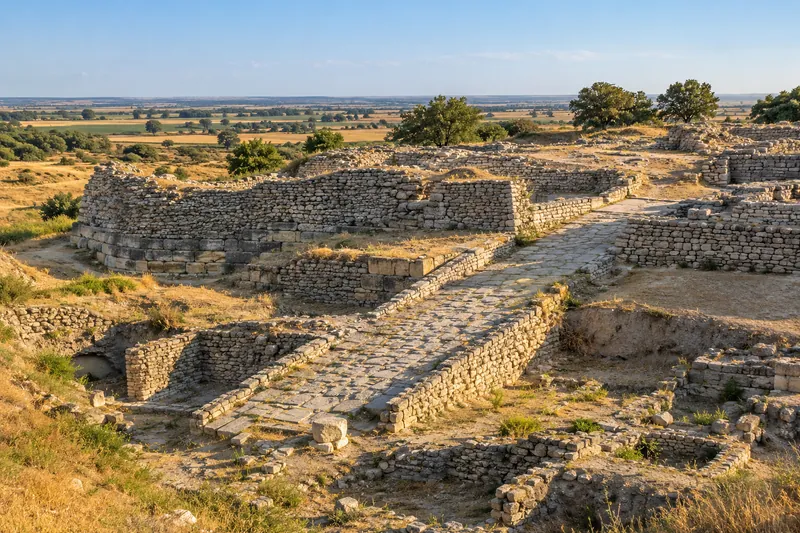
The mound of Troy holds nine main settlement layers, numbered Troy I to Troy IX, built one on top of another over more than 3,000 years. Archaeologists also divide these into many smaller phases.
The oldest layer, Troy I, dates to the Early Bronze Age, around 3000 BC. The settlement continued through the Greek and Roman periods, when it was known as Ilion. Troy II is famous for its fortifications and treasure finds. Troy VI, with its massive sloping stone walls, and Troy VIIa are the layers most often linked to the Late Bronze Age city that Homer's Iliad describes. A walking path loops through the site with numbered signs, color-coded by period. A guide helps you see which wall belongs to which city, because the layers overlap in ways that are hard to read on your own.
Heinrich Schliemann and the Great Trench
Heinrich Schliemann, a German businessman turned archaeologist, began digging at Hisarlık in the early 1870s, convinced he would find Homer's Troy. UNESCO dates his first excavations to 1870.
Schliemann cut a deep north to south trench straight through the mound to reach the oldest levels. It is still visible today and shows the layers in cross section, but it also destroyed much of the later material he passed through. In 1873 he found a hoard of gold and silver he called "Priam's Treasure." It turned out to be far older than the Trojan War era, and he took it out of the Ottoman Empire. Much of it is now in Moscow. Later excavators, including Wilhelm Dörpfeld, Carl Blegen and Manfred Korfmann, refined the dating. Turkish teams continue the work today.
Walls, gates and the ramp
The most impressive standing remains are the Troy VI walls on the east and south sides of the citadel, built of carefully fitted limestone blocks with a deliberate slope. UNESCO notes that excavations have revealed 23 sections of defensive walls and eleven gates.
Near the top of the mound you will see a stone-paved ramp from Troy II, which once led up to the citadel gate. A protective roof covers some of the mudbrick remains from the early levels, including the outline of a megaron, the long hall type that appears in early Aegean architecture. From the higher points, look west across the plain toward the Aegean. In the Bronze Age, the coastline was much closer, and this view helps explain why the site controlled the approach to the Dardanelles.
The Roman theater and sanctuary
On the southwest side of the site, the Roman-era remains show the later city of Ilion, which Romans honored as the mythical homeland of their ancestor Aeneas.
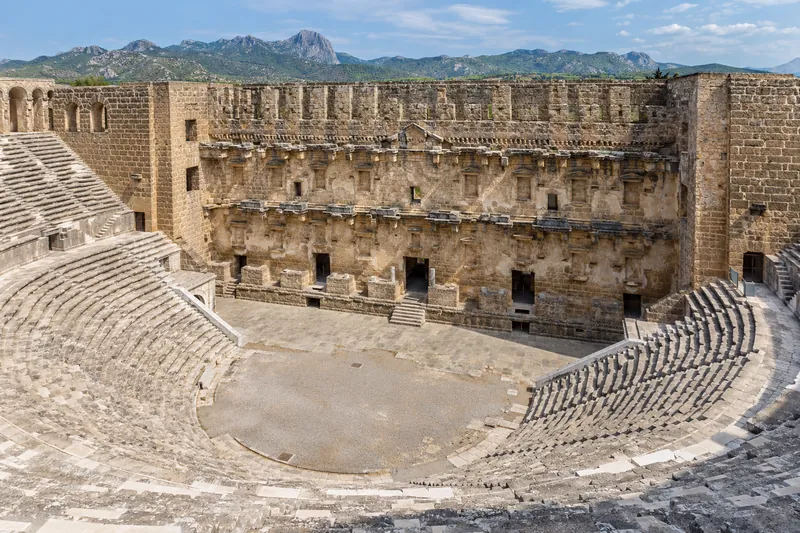
You will find a small Roman odeon (a covered theater for music and speeches) and a council house, along with the area of the sanctuary used for sacrifices in Greek and Roman times. These are the easiest parts of the site to picture as working spaces. Coming at the end of the walking loop, they are a good place to rest on the seating and talk through what you have seen.
The wooden horse replica at the site
A large wooden horse stands near the entrance of the archaeological site. It was built in 1975 and is meant as a symbol of the legend, not a reconstruction of anything found here.
The horse is two stories high and, when open, you can climb inside and look out through small windows. It is the most photographed spot at Troy, and families tend to enjoy it. Remember that the Trojan Horse story comes from later Greek and Roman literature. Homer's Iliad ends before the fall of the city. The horse is a fun stop, but the real history is in the walls behind it.
The Troy Museum
The Troy Museum opened in October 2018, about 800 meters from the archaeological site. The rust-colored cube was designed by the Turkish firm Yalın Mimarlık, and the building's height echoes the depth of the excavations at the mound.
Inside, a ramp winds down through four floors, moving through the region's history from prehistory to the Ottoman period. Highlights include the Polyxena sarcophagus, a marble tomb carved with a scene from the Trojan War, found in 1994. You will also see Bronze Age pottery, gold jewelry, Roman sculpture and finds from other sites in the Troad, the ancient name for this region. Visit the museum first if you like context before you see the ruins. Visit it after if you prefer to see the site with fresh eyes.
Çanakkale and the film horse
Çanakkale, your base for Troy, is a lively waterfront city on the Dardanelles. Its seafront promenade has restaurants, cafés and a second wooden horse.
This one was used in the 2004 Hollywood film Troy and was brought to Çanakkale after filming. It stands on the waterfront and makes a quick photo stop in the evening. The city also works as a base for Gallipoli, which is across the strait by ferry or by the 1915 Çanakkale Bridge.
Tickets and opening hours (as of October 2026)
A single ticket is reported to cover both the Troy archaeological site and the Troy Museum. Both are open every day.
| Site |
Ticket for foreign visitors |
Hours |
Notes |
| Troy archaeological site + Troy Museum |
€27 |
08:30 to 17:30, last tickets 17:00 (muze.gov.tr) |
Open daily. Longer summer hours reported |
| Troy Museum |
Included in the ticket above |
08:30 to 17:30, last tickets 17:00 (muze.gov.tr) |
Open daily. About 800 m from the site |
| MuseumPass Türkiye |
€165 |
Valid 15 days from first visit |
Covers more than 350 state museums and sites. Usually worth it only on a long, site-heavy trip |
Turkey's Ministry of Culture and Tourism has announced new museum prices for 2027, so check the official site before you travel. Audio guides are available at the site and museum.
Best time to visit
April to early June and September to October are the most comfortable months for Troy. The site is open and exposed, so summer afternoons are hot, and winter can be windy and wet.
| Months |
Weather |
Crowds |
Notes |
| March to April |
Cool to mild, some rain |
Light, busier around late April |
Pleasant for walking |
| May to June |
Warm and pleasant |
Moderate, Turkish school groups on weekdays |
Good walking weather |
| July to August |
Hot, very little shade |
Moderate |
Go at opening time, then the museum |
| September to October |
Warm, settled |
Lighter |
Comfortable for a full visit |
| November to February |
Cold, often windy |
Quiet |
Museum is a good indoor option |
Guide's tip
Before you walk the site, stand at the edge of Schliemann's trench and look at the layers in the cut. It is the clearest way to understand that Troy is nine cities stacked on top of each other. Then follow the numbered path in order, so the periods make sense as you go.
Practical tips
- Wear comfortable shoes with grip. Paths include gravel, uneven stone and some steps.
- Bring a hat, sunscreen and water. There is very little shade on the mound.
- There is no dress code at Troy or the museum.
- The plain is exposed to wind. A light jacket helps outside summer.
- Personal photography is generally allowed. Drones are not permitted without official permission at Turkish archaeological sites.
- The museum is the more accessible part of the visit. The archaeological site has uneven ground and limited step-free routes.
- Carry a card and a little Turkish lira for small purchases. Ticket prices are set in euros for foreign visitors at many major sites, but you can usually pay by card.
Common myths about Troy
- Myth: The wooden horse at Troy is ancient. Fact: The horse at the site is a modern replica. The story of the wooden horse comes from later Greek and Roman literature, not from the excavations.
- Myth: There was a single city of Troy. Fact: Archaeologists have identified at least nine main layers of settlement, Troy I to Troy IX, spanning roughly 4,000 years.
From our guides' blog
Sources
FAQ
Is Troy worth visiting?
Yes, if you go with the right expectations. Troy is a complex archaeological site, not a grand ruined city like Ephesus. With a guide and a visit to the Troy Museum, you see how nine cities were built on one mound over thousands of years, and where the story of the *Iliad* meets real history.
How long do you need at Troy?
Plan about two hours for the archaeological site and one to one and a half hours for the Troy Museum. Three to four hours in total covers both comfortably. Most travelers visit in a morning and continue to Assos, Pergamon or Gallipoli the same day.
Can you go inside the Trojan Horse at Troy?
Yes. The wooden horse near the site entrance, built in 1975, is two stories high, and visitors can usually climb inside and look out of its windows. It is a symbolic replica, not an ancient find. A second horse from the 2004 film *Troy* stands on the Çanakkale waterfront.
How far is Troy from Istanbul?
Troy is about five and a half hours from Istanbul by road, crossing the 1915 Çanakkale Bridge. A day trip is possible but long. Most travelers stay a night in Çanakkale and combine Troy with Gallipoli, then continue south toward Pergamon and Ephesus.
Is the real city of Troy in Turkey?
Yes. Most archaeologists identify the mound of Hisarlık in northwest Turkey as ancient Troy, also called Ilion. Layers Troy VI and VIIa, from the Late Bronze Age, are the ones most often linked to the city in Homer's *Iliad*. UNESCO listed the site as a World Heritage Site in 1998.
Do I need separate tickets for Troy and the Troy Museum?
Current reports say one ticket covers both the archaeological site and the Troy Museum. Confirm on the official muze.gov.tr website before you go, as policies and prices change. Both are open daily, and the museum is about 800 meters from the site.
Can you visit Troy and Gallipoli in one day?
Yes, but it is a full day. The two are about an hour apart, including the ferry or bridge crossing. With an early start, you can cover the main Gallipoli memorials and still spend two to three hours at Troy. Staying overnight in Çanakkale makes the pace much easier.
How do you get to Troy?
Troy stands on the mound of Hisarlık, near the village of Tevfikiye in Çanakkale Province. According to UNESCO, the site lies 4.8 km from the southern entrance to the Dardanelles. Çanakkale city is about a 30 to 40 minute drive away. From Istanbul, the drive to Troy takes about five and a half hours.
When is the best time to visit Troy?
April to early June and September to October are the most comfortable months for Troy. The site is open and exposed, so summer afternoons are hot, and winter can be windy and wet.
Is Troy a UNESCO World Heritage Site?
Yes. It is on the UNESCO World Heritage List as “Archaeological Site of Troy”, inscribed in 1998.
Which private tours include Troy?
Several of our private tours include Troy, starting from 11 days. They are listed at the top of this page with routes and prices per person.