Safranbolu at a glance
| Where | Karabük Province, 230 km (143 miles) north of Ankara |
|---|
| Getting there | By road; a night here splits the Istanbul to Cappadocia drive into two easy days |
|---|
| Time needed | 1 night and a full morning |
|---|
| Best time to visit | April to June and September to October |
|---|
| UNESCO World Heritage | City of Safranbolu (1994) |
|---|
| Our private tours | Included in our 12-day tour; see it above |
|---|
Summarize this guide with an AI assistant
Where is Safranbolu and how do you get there?
Safranbolu is in Karabük Province, inland from the western Black Sea coast, about 230 km (143 miles) north of Ankara.
Without a stop, Istanbul to Cappadocia is one very long day in a car. A night in Safranbolu gives you two manageable driving days instead.
| Route |
Distance |
Driving time (approx.) |
| Istanbul to Safranbolu |
410 km / 255 mi |
4.5 to 5 hours |
| Ankara to Safranbolu |
230 km / 143 mi |
About 3 hours |
| Safranbolu to Göreme (Cappadocia) |
440 km / 273 mi |
6 to 6.5 hours |
A private vehicle is the easiest way to combine the town with the sights around it.
How much time do you need?
One night and a full morning are enough for most travelers. Arrive by mid-afternoon, walk the old town before dinner, and use the next morning for a museum house and one outlying sight before driving on.
A second night lets you add Yörük Village, Tokatlı Canyon and Bulak Mencilis Cave without rushing.
What to see in Safranbolu
The Ottoman mansions and the three districts
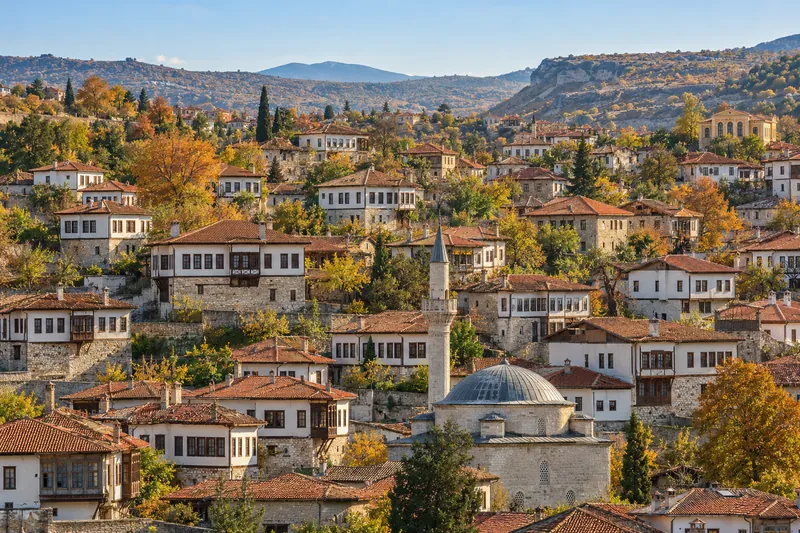
Safranbolu was inscribed on the UNESCO World Heritage List in 1994 as one of the most complete surviving Ottoman towns. UNESCO says it became an important caravan station by the 13th century, and its architecture peaked in the 17th century.
The historic town has three parts. Çarşı, the old market quarter, sits in a hollow between two streams. Kıranköy was historically a non-Muslim neighborhood with stone houses. Bağlar, "the vineyards," is where wealthy families moved for the summer, with houses set in large gardens. The classic house has a stone ground floor, timber-framed upper floors with whitewashed plaster, projecting bays and rows of windows.
Çarşı and the Old Bazaar
The Çarşı quarter is where you will spend most of your time. Its cobbled lanes run downhill past workshops, tea gardens and shops selling local sweets.
Look for the Yemeniciler Arastası, a covered row of small shops historically used by makers of yemeni, traditional flat leather shoes. The Ministry of Culture carried out Turkey's first urban-scale restoration project on the street behind the arasta in 1989 and 1990. Beyond it, the blacksmiths' street still has a handful of working forges, where you can hear hammers on iron and buy hand-forged knives, hooks and tools. The saddlers' bazaar (Semerciler) recalls the town's caravan past, when pack animals carried goods across Anatolia.
Cinci Han caravanserai
Cinci Han is the town's landmark building, a large stone caravanserai built between about 1640 and 1648 by Cinci Hoca, also known as Kazasker Hüseyin Efendi, a powerful figure at the court of Sultan İbrahim.
Inside, two stories of arcaded galleries surround a courtyard, with rooms where traveling merchants once slept and a ground-floor hall for their animals. Today the building operates as a hotel. Non-guests can usually step in for a look at the courtyard or climb to the roof for views over the tiled rooftops, so ask at the entrance.
İzzet Mehmet Paşa Mosque and the clock tower
The İzzet Mehmet Paşa Mosque, completed in 1796, is the most elegant mosque in Çarşı. Its founder was born in Safranbolu and served as grand vizier to Sultan Selim III from 1794 to 1798.
The interior shows the late Ottoman taste for European-style decoration, and the founder's tomb stands in the courtyard. He also paid for the town's clock tower, built in 1797 on the hill above the market. Next to the tower, the City History Museum (Kent Tarihi Müzesi) occupies the former government house, built in 1904 to 1906, and covers local crafts and daily life. The older Köprülü Mehmet Paşa Mosque nearby has a sundial in its courtyard.
Kaymakamlar Museum House
The Kaymakamlar Museum House (Kaymakamlar Gezi Evi) is the best place to see inside a traditional Safranbolu mansion. The house is generally dated to the late 18th or early 19th century.
It is furnished as a family home of its period, with scenes of daily life such as a bride's room, a kitchen and a guest room. Look for the details that made these houses practical: the revolving cupboard (dönme dolap) that let food pass between rooms without the women being seen, built-in bath cupboards, and the large central hall. Allow 30 to 45 minutes.
Hıdırlık Hill viewpoint
Hıdırlık Hill, just south of the old town, gives the classic panoramic view of Çarşı's red-tiled roofs and minarets. It is a short, steep walk up from the bazaar.
On top you will find a small park with benches, a tea garden and the mid-19th-century tomb of Hasan Paşa, an Ottoman district governor. Late afternoon light is the most flattering for photos.
Yörük Village
Yörük Village (Yörükköy) is a small hamlet about 11 km (7 miles) east of Safranbolu, with the same style of timber-framed houses in an even quieter, rural setting.
The village was settled by families of nomadic Yörük origin and grew prosperous over the following centuries. Its narrow lanes, stone fountains and large family houses are protected as a historic site. One or two mansions are open to visitors, and the old village laundry house is a common stop. Plan about an hour, ideally on your way out of town.
İncekaya Aqueduct and the Tokatlı Canyon glass terrace
North of town, Tokatlı Canyon cuts deep into the limestone. Two sights sit along it, about 7.5 km (4.5 miles) from the center.
The İncekaya Aqueduct dates to the 18th century and is associated with İzzet Mehmet Paşa. It is roughly 116 m (380 ft) long and stands about 60 m (200 ft) above the canyon, and you can walk across it. Close by, the Kristal Cam Teras is a glass viewing platform that juts out over the canyon edge, about 80 m (260 ft) above the floor. It is a short stop, usually 20 to 30 minutes, and lines can form on weekends.
Bulak Mencilis Cave
Bulak Mencilis Cave is a show cave northwest of Safranbolu, with a cave system about 6.5 km (4 miles) long. Roughly 400 m (1,300 ft) has lit paths for visitors.
To reach the entrance, you climb about 150 stone steps from the ticket office to an opening in a cliff face. Inside, walkways and stairs lead past stalactites, stalagmites and an underground stream. It stays cool and damp year round, so bring a light layer and shoes with grip.
Saffron, lokum and staying in a mansion
The town's name comes from saffron, which was historically grown in the area. Today it is still cultivated in nearby villages such as Davutobası, and harvest takes place in late October and November.
You will see saffron sold in tiny packets and used in saffron lokum (Turkish delight) and in zerde, a saffron rice pudding. Safranbolu lokum is a local specialty, and shops offer samples. The other local experience is the stay itself. Many mansions have been converted into small hotels with carpeted rooms, wooden ceilings and cushioned window seats.
Tickets and opening hours (as of October 2026)
Most of Safranbolu is free to walk. The museum house, City History Museum, glass terrace and cave charge small entry fees in Turkish lira. These are run by local authorities, not the Ministry of Culture, so Müzekart and MuseumPass Türkiye are not valid at most of them.
| Site |
Ticket for foreign visitors |
Hours |
Notes |
| Old town, bazaar, Hıdırlık Hill |
Free |
Always open |
Shops mostly open about 09:00 to 19:00 |
| Kaymakamlar Museum House |
About 100 TL |
09:00 to 17:30 |
Steep stairs |
| City History Museum |
|
|
Next to the clock tower |
| Cinci Han |
Small fee for non-guests |
|
Operates as a hotel |
| Tokatlı Canyon glass terrace |
|
Daytime, open year round |
Müzekart not valid |
| Bulak Mencilis Cave |
|
|
About 150 steps to the entrance |
| İzzet Mehmet Paşa Mosque |
Free |
Outside prayer times |
Modest dress required |
On our private tours, entrance fees for sites in the itinerary are included.
Best time to visit
April to June and September to October are the best months. Safranbolu sits inland at a higher elevation than Istanbul, so winters are cold and can be snowy, while summer days are warm and evenings cool.
| Months |
Weather |
Crowds |
Notes |
| March to April |
Cool, some rain |
Light on weekdays |
Bring a warm layer for evenings |
| May to June |
Mild to warm |
Busy on weekends with Turkish visitors |
Gardens in Bağlar are green |
| July to August |
Warm days, pleasant evenings |
Moderate |
Good time for the canyon and cave |
| September to October |
Mild, settled |
Moderate, busy on weekends |
Saffron harvest begins late October |
| November to February |
Cold, snow possible |
Quiet |
Atmospheric, with wood smoke over the rooftops |
If you can, plan your overnight on a weekday.
Guide's tip
Stay in the Çarşı quarter, not in a modern hotel outside the old town. The magic of Safranbolu starts after the day buses leave: walk the lanes after dinner, then go up Hıdırlık Hill early the next morning, before the shops open, when you will often have the view to yourself.
Practical tips
- Wear shoes with good grip. The cobblestones are uneven, steep in places and slippery after rain.
- Mosques require covered shoulders and knees, and a headscarf for women. Carry a light scarf.
- Mansion hotels have steep stairs and rarely have elevators. Tell us in advance if stairs are a problem so we can request a ground-floor room.
- Bring a warm layer outside July and August. Evenings in the valley are cool.
- Carry some Turkish lira in cash for small shops, workshops and entrance fees. Larger shops accept cards.
- Ask before photographing craftsmen at work.
- Drones need official permission over the historic town.
Sources
- City of Safranbolu, UNESCO World Heritage Centre
- Where to Visit: Safranbolu, Republic of Türkiye Ministry of Culture and Tourism
- Safranbolu, Tarihi Kentler Birliği (Union of Historic Towns)
- View the city from the castle and Hıdırlık Hill, Visit Karabük
- Safranbolu's heritage at the City History Museum, İstiklal
- İncekaya Aqueduct, Wikipedia
- Tokatlı Kanyonu, Küre Ansiklopedi
- Tokatlı Kanyonu entry and Müzekart, Sabah
- Mencilis Mağarası, Showcaves.com
- Kaymakamlar Gezi Evi, Karabük 78
- Safranbolu: Ottoman town and historic caravan stop, Ancient History Sites
- Istanbul to Safranbolu, Rome2rio
- Safranbolu to Göreme, Rome2rio
FAQ
Is Safranbolu worth visiting?
Yes, if you enjoy history, architecture and slow evenings. Safranbolu is one of the best-preserved Ottoman towns in Turkey, listed by UNESCO in 1994. It also breaks up the long drive from Istanbul to Cappadocia, so you gain an extra experience instead of spending a whole day on the highway.
How many days do you need in Safranbolu?
One night and a morning cover the old town, a museum house, Hıdırlık Hill and either the glass terrace or Yörük Village. Two nights let you add Bulak Mencilis Cave and the canyon trail at a relaxed pace. Most travelers on a 10 to 14 day Turkey trip spend one night.
How far is Safranbolu from Istanbul?
Safranbolu is about 410 km (255 miles) from Istanbul by road, roughly four and a half to five hours with a stop. It works much better as an overnight stop on the way from Istanbul to Cappadocia or Ankara.
Can you stop in Safranbolu between Istanbul and Cappadocia?
Yes, and it is one of the best reasons to go. Istanbul to Safranbolu is about five hours, and Safranbolu to Göreme in Cappadocia is about six to six and a half hours. Splitting the trip with a night in Safranbolu turns one exhausting drive into two reasonable days.
What is Safranbolu famous for?
Safranbolu is famous for its timber-framed Ottoman mansions, its 17th-century Cinci Han caravanserai and its old bazaar of blacksmiths and craftsmen. The name comes from saffron, historically grown in the area, and the town is also known for saffron-flavored Turkish delight.
Can you stay in a historic mansion in Safranbolu?
Yes. Many Ottoman mansions in the Çarşı and Bağlar quarters have been restored as small hotels, with wooden ceilings, carpets and window seats. Expect charm rather than large rooms, and steep stairs without elevators. Ask for a room in the main house if you want the full experience.
How do you get to Safranbolu?
Safranbolu is in Karabük Province, inland from the western Black Sea coast, about 230 km (143 miles) north of Ankara. Without a stop, Istanbul to Cappadocia is one very long day in a car. A night in Safranbolu gives you two manageable driving days instead.
When is the best time to visit Safranbolu?
April to June and September to October are the best months. Safranbolu sits inland at a higher elevation than Istanbul, so winters are cold and can be snowy, while summer days are warm and evenings cool.
Is Safranbolu a UNESCO World Heritage Site?
Yes. It is on the UNESCO World Heritage List as “City of Safranbolu”, inscribed in 1994.
Which private tours include Safranbolu?
Our 12-day private tour includes Safranbolu. You will find it at the top of this page, with the full itinerary and prices.