Göbekli Tepe at a glance
| Where | A limestone ridge about 15 km northeast of Şanlıurfa, southeast Turkey |
|---|
| Getting there | Fly to Şanlıurfa GAP Airport (GNY), then a 20 to 30 minute drive from the city |
|---|
| Time needed | 2 to 3 hours, including the visitor center |
|---|
| Best time to visit | April to May and late September to November |
|---|
| UNESCO World Heritage | Göbekli Tepe (2018) |
|---|
| Our private tours | 2 of our private tours include Göbekli Tepe, starting from 6 days |
|---|
Summarize this guide with an AI assistant
Where is Göbekli Tepe and how do you get there?
Göbekli Tepe sits on a limestone ridge in the Germuş mountains, about 15 km northeast of Şanlıurfa city center. The usual route is a domestic flight to Şanlıurfa, then a 20 to 30 minute drive.
- Şanlıurfa GAP Airport (GNY): about 34 km northeast of the city center. Direct flights connect it with Istanbul and Ankara.
- By road: Şanlıurfa is roughly two hours by road from Gaziantep, which makes it easy to combine with Gaziantep, Mount Nemrut and Mardin on a regional loop.
There is no public transport to the site that is practical for a short visit, so you need a car, taxi or tour vehicle.
How much time do you need?
Allow 2 to 3 hours at Göbekli Tepe itself, including the visitor center and shuttle. To see the site properly together with Karahan Tepe, the Şanlıurfa Archaeology Museum, Balıklıgöl and Harran, plan 2 nights in Şanlıurfa.
A typical plan is Göbekli Tepe and the museum on one day, then Karahan Tepe and Harran on the next. If you only have one day, choose Göbekli Tepe in the morning, the museum in the afternoon and Balıklıgöl at sunset. Start early in summer, because the site is exposed and afternoons are very hot.
What to see around Göbekli Tepe
Göbekli Tepe
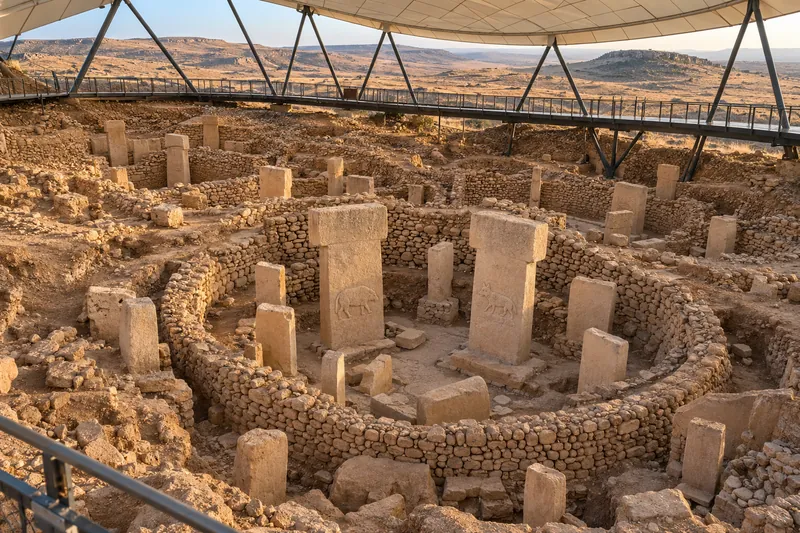
Göbekli Tepe is a group of round and oval stone enclosures built by hunter-gatherers in the Pre-Pottery Neolithic period, between about 9600 and 8200 BC according to UNESCO. That is several thousand years before pottery, writing or the wheel. Inside the enclosures stand T-shaped limestone pillars, some up to 5.5 meters tall, carved with foxes, boars, snakes, vultures and other animals. Some pillars have carved arms and hands, which suggests they represent human-like figures.
UNESCO inscribed the site as a World Heritage Site in 2018. A large protective roof covers the main excavated enclosures. Visitors follow a set route on a wooden walkway and cannot enter the enclosures themselves, which protects the remains.
The visitor center
The visit starts at a visitor center at the main entrance, with ticket office, exhibits, a café and a shop. From there a shuttle, included in the ticket, takes you up to the excavation area. You can also walk the path, roughly one kilometer. Spending 20 to 30 minutes in the visitor center first helps, because the exhibits explain the layers, the dating and what the carvings show before you see the real thing.
Şanlıurfa Archaeology Museum
The museum in central Şanlıurfa holds finds from Göbekli Tepe and other sites in the region, displayed across 14 halls with a full-size replica of one Göbekli Tepe enclosure. A highlight is the Balıklıgöl Statue, also called Urfa Man, a Neolithic limestone figure that the Ministry presents as one of the oldest known life-size human statues. The museum is large, so allow at least 2 hours. The Haleplibahçe Mosaic Museum, in the same park, displays Roman-era floor mosaics, including a scene of Amazon women warriors.
Karahan Tepe and the Taş Tepeler project
Karahan Tepe is a related Neolithic site about an hour's drive east of Şanlıurfa, inside Tektek Mountains National Park. It has many T-shaped pillars and a rock-cut chamber with a carved human head emerging from the wall, along with snake carvings. It belongs to the Taş Tepeler ("Stone Hills") project, a Ministry of Culture and Tourism research program covering 12 Neolithic sites in the Şanlıurfa region. Facilities are simpler than at Göbekli Tepe. Allow about an hour on site, and bring water.
Balıklıgöl (Pool of Abraham)
Balıklıgöl is a pair of spring-fed pools in the old city of Şanlıurfa, surrounded by mosques, gardens and a covered market. Local tradition links the site to the prophet Abraham, and the carp in the pools are considered sacred, so fishing is forbidden. It is free and open to the public. Visit in late afternoon, when families come out and the light is softer. Dress modestly if you enter the mosques, and remove shoes inside.
Harran
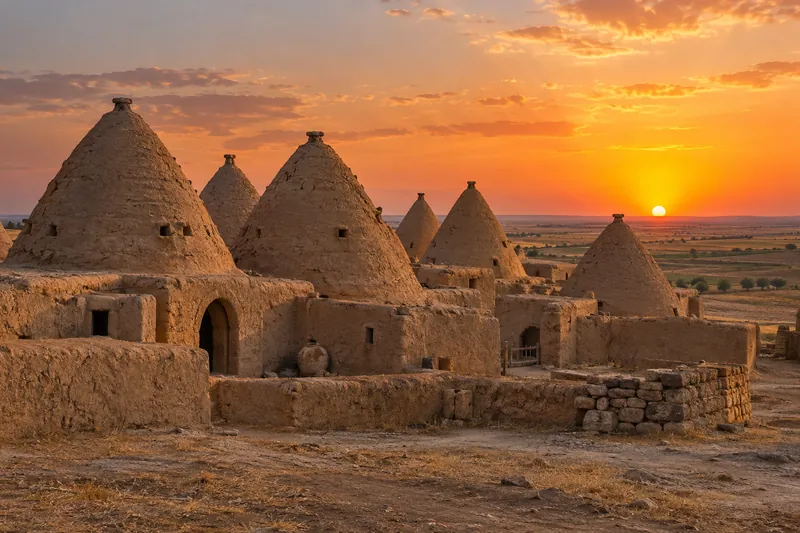
Harran is about 40 km southeast of Şanlıurfa, on the Harran plain. It is known for its beehive-shaped mud-brick houses, a building style kept alive into the 20th century. You can also see the ruins of the 8th-century Great Mosque with its tall square minaret, the old city walls and a castle. Harran is mentioned in the Book of Genesis in connection with Abraham. Allow 1.5 to 2 hours. There is little shade.
Tickets and opening hours (as of October 2026)
Hours below are listed by the Ministry of Culture and Tourism on muze.gov.tr. We could not load official foreign-visitor prices from the Ministry's site. Price figures shown are from recent 2026 travel sources and must be confirmed before publishing.
| Site |
Ticket for foreign visitors |
Hours |
Notes |
| Göbekli Tepe |
€20 |
08:30–17:30, last tickets 17:00, open daily |
Shuttle from visitor center included; seasonal hours |
| Karahan Tepe |
Reported free; (may share a ticket with Göbekli Tepe) |
|
Simpler facilities |
| Şanlıurfa Archaeology Museum and Haleplibahçe Mosaic Museum |
|
08:30–17:30, last tickets 17:00, open daily |
Allow 2+ hours |
| Balıklıgöl |
Free |
Open public area |
Mosques close briefly at prayer times |
| Harran |
|
|
|
Passes: The Museum Pass Türkiye is accepted at Ministry sites. The MüzeKart is for Turkish citizens and residents. An audio guide is available at Göbekli Tepe.
Best time to visit
Spring (April to May) and fall (late September to November) are the most comfortable months. Summers in Şanlıurfa are long and very hot, and the sites have little shade. Winter is mild by day but can be cool and rainy.
| Months |
Weather |
Crowds |
Notes |
| December–February |
Cool, some rain, cold nights |
Low |
Quiet sites; shorter daylight |
| March–May |
Mild to warm, green fields in spring |
Moderate |
Comfortable for walking outdoor sites |
| June–August |
Very hot and dry |
Low to moderate |
Visit at opening; rest midday |
| September–November |
Hot in early September, then warm and dry |
Moderate |
Comfortable from late September |
Guide's tip
See Göbekli Tepe first thing in the morning, then visit the Şanlıurfa Archaeology Museum in the afternoon. The museum's finds and full-size replica make much more sense once you have stood above the real enclosures, and you spend the hottest hours of the day indoors.
Practical tips
- Heat: From June to early September, start at opening time, wear a hat and carry water. The walkway at Göbekli Tepe is mostly under the roof, but approaches are exposed.
- Shoes: Comfortable walking shoes are enough. Paths at Karahan Tepe and Harran are uneven and dusty.
- Dress: Şanlıurfa is a conservative city with important religious sites. Cover shoulders and knees, and women should bring a scarf for mosques around Balıklıgöl.
- Photography: Allowed at the archaeological sites from the walkways. Do not step off marked paths, and never pick up stones or objects; the sites are under video surveillance and Turkish antiquities laws are strict.
- Accessibility: The Göbekli Tepe shuttle and walkway make it one of the easier archaeological sites in Turkey for travelers with limited mobility. Karahan Tepe and Harran have rougher ground.
- Cash: Carry Turkish lira for small shops and the bazaar near Balıklıgöl. Cards work in hotels and most restaurants.
- Food: Şanlıurfa is known for its kebabs, isot pepper and late-night sıra gecesi music gatherings. Ask your guide for a local place.
- Tipping: For a private guide and driver, a tip at the end of the trip is customary but not required.
Common myths about Göbekli Tepe
- Myth: It is settled that Göbekli Tepe was only a temple. Fact: Early excavators described it as a temple. More recent research has found evidence that people also lived on the site, and the interpretation is still developing.
Sources
- Göbekli Tepe, UNESCO World Heritage Centre
- Göbeklitepe Örenyeri, Ministry of Culture and Tourism, muze.gov.tr
- Şanlıurfa Arkeoloji Müzesi, muze.gov.tr
- Visiting Göbekli Tepe, German Archaeological Institute (DAI) blog
- Taş Tepeler project fifth anniversary, Directorate of Communications
- Karahantepe Settlement Site, Turkish Airlines Blog
- Şanlıurfa GAP Airport, Wikipedia
- Harran, Wikipedia
- Göbeklitepe Gezi Rehberi 2026, sanliurfa.com (secondary source for current price)
FAQ
Is Göbekli Tepe worth visiting?
Yes, if you are interested in archaeology or early human history. The carved pillars date to about 9600 to 8200 BC, built by hunter-gatherers before farming took hold. Seeing the site with the Şanlıurfa Archaeology Museum and Karahan Tepe gives a clear picture of the region's Neolithic story, and Şanlıurfa itself is an interesting old city.
How old is Göbekli Tepe?
UNESCO dates the enclosures to the Pre-Pottery Neolithic period, between about 9600 and 8200 BC, which is roughly 11,000 to 11,600 years ago. That makes them thousands of years older than Stonehenge or the Egyptian pyramids. The site was first identified in 1963, and large-scale excavations began in 1995.
How long does it take to visit Göbekli Tepe?
Plan 2 to 3 hours, including the visitor center, the shuttle ride and the walkway around the enclosures. To combine it with the Şanlıurfa Archaeology Museum, Karahan Tepe, Balıklıgöl and Harran without rushing, spend 2 nights in Şanlıurfa.
How do I get to Göbekli Tepe from Istanbul?
Fly from Istanbul to Şanlıurfa GAP Airport (GNY), which takes under two hours. The airport is about 34 km from the city center, and Göbekli Tepe is about 15 km northeast of the city. You need a car, taxi or tour vehicle for the final stretch, since public transport to the site is not practical.
Can you visit Karahan Tepe?
Yes. Karahan Tepe is open to visitors and lies about an hour's drive east of Şanlıurfa. It is part of the Taş Tepeler project, which studies 12 Neolithic sites in the region. Facilities are simpler than at Göbekli Tepe, so bring water and sun protection. Check the current ticket arrangement before you go.
What is the best time to visit Göbekli Tepe?
Spring (April to May) and fall (late September to November) are the most comfortable. Summer is very hot in Şanlıurfa, so if you go then, arrive at opening time. Winter is quiet and mild by day, though it can be cool and rainy.
Is Göbekli Tepe a UNESCO World Heritage Site?
Yes. It is on the UNESCO World Heritage List as “Göbekli Tepe”, inscribed in 2018.
Which private tours include Göbekli Tepe?
Several of our private tours include Göbekli Tepe, starting from 6 days. They are listed at the top of this page with routes and prices per person.