Pergamon at a glance
| Where | A steep hill above Bergama, in the north of İzmir Province |
|---|
| Getting there | By road from İzmir: 100 km (62 miles), about 1.5 hours |
|---|
| Time needed | 5 to 6 hours for the Acropolis, the Asclepion and the Red Basilica |
|---|
| Best time to visit | April, May, late September and October |
|---|
| UNESCO World Heritage | Pergamon and its Multi-Layered Cultural Landscape (2014) |
|---|
| Our private tours | 5 of our private tours include Pergamon, starting from 5 days |
|---|
Summarize this guide with an AI assistant
Where is Pergamon and how do you get there?
Pergamon sits on and around a steep hill above Bergama, a market town in the north of İzmir Province. The usual approach is by road from İzmir, or as a stop on the drive between Troy (Çanakkale) and Ephesus.
- From İzmir city: about 62 miles (100 km), roughly 1.5 hours by car.
- From İzmir Airport (ADB): allow about 1.5 to 2 hours, depending on traffic around the city.
- From Kuşadası or Selçuk (Ephesus): about 2.5 hours by road, roughly 110 miles (175 km). It is a long day trip but doable with a private driver. It is not realistic on a single cruise port day if you also want to see Ephesus.
- From Çanakkale (Troy): about 155 miles (250 km), roughly 3 to 3.5 hours.
The sites are spread out. The Red Basilica stands in the middle of town, the Bergama Archaeology Museum is a short walk from it, the Asclepion is on the western edge of town, and the Acropolis is on the hilltop about 1,000 feet (300 m) above. You need a vehicle to link them.
How much time do you need?
Plan 5 to 6 hours for the three main sites: about 2 to 2.5 hours on the Acropolis, 1 to 1.5 hours at the Asclepion and 30 to 45 minutes at the Red Basilica. Add 45 minutes if you want the museum. Most travelers make it a long stop on a travel day.
What to see in Pergamon
Pergamon was the capital of the Attalid kings from the 3rd century BC until the last of them left the kingdom to Rome in 133 BC. UNESCO listed it in 2014 as "Pergamon and its Multi-Layered Cultural Landscape," a serial site that covers the hilltop city, the Asclepion, the Red Basilica, tumuli and a rock-cut sanctuary outside town.
The cable car up to the Acropolis
The Bergama Acropolis cable car opened in 2010 and runs about 2,300 feet (700 m) from the lower town to near the Acropolis entrance, climbing roughly 790 feet (240 m) in about four minutes. It is run by a company owned by Bergama Municipality and has its own ticket, separate from the site entry. A private vehicle can also drive you to the upper parking area.
Temple of Trajan
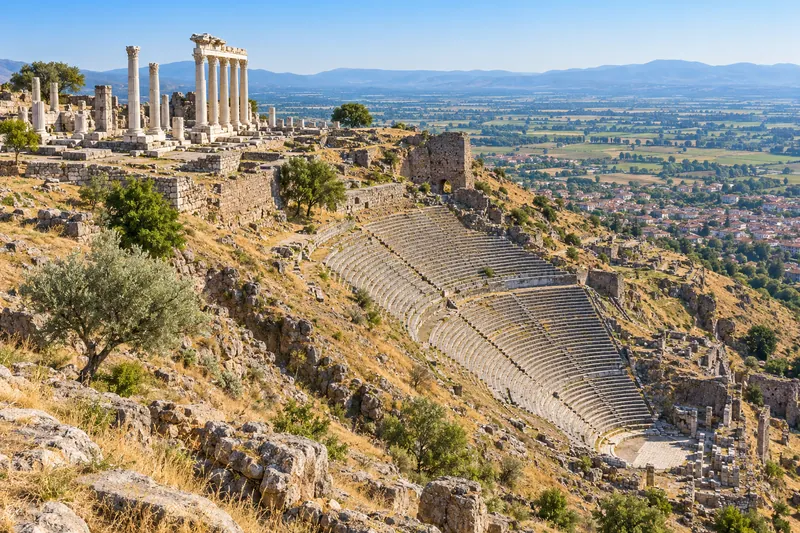
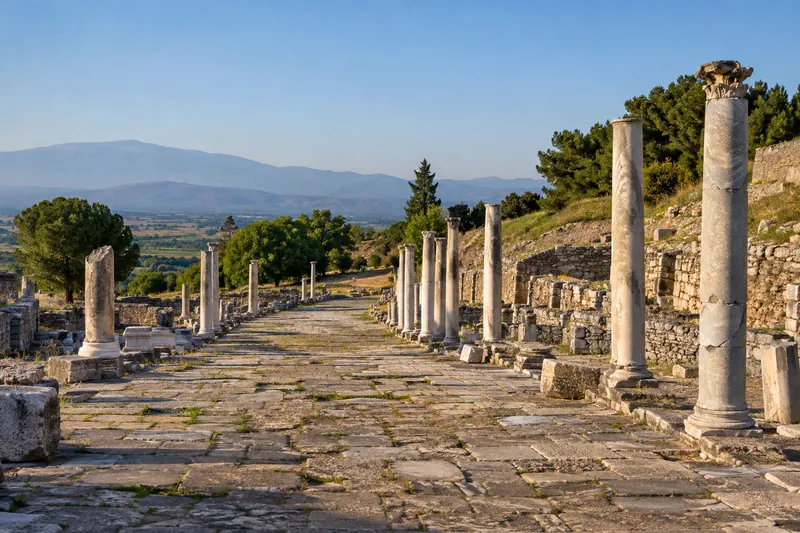
The white marble Corinthian temple on the highest terrace is the Trajaneum, dedicated to the deified Emperor Trajan and completed under Hadrian in the 2nd century AD. Part of its columns and pediment have been re-erected by German archaeologists, so it reads clearly from far below. The terrace stands on massive vaulted substructures, visible from its edge.
The theater
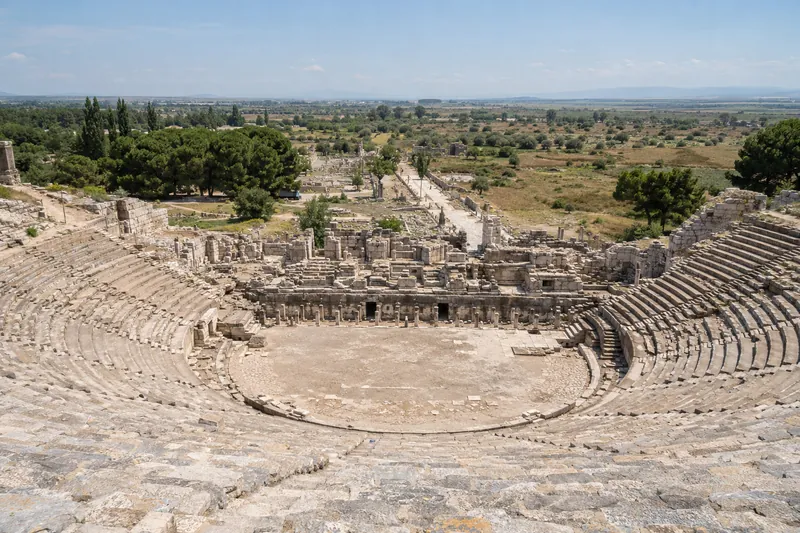
Pergamon's Hellenistic theater is the part most visitors remember. It holds about 10,000 people and is cut into the western slope so steeply that it is often called the steepest theater of the ancient world. From the top rows you look straight down over the Bakırçay Plain and the dam lake. The stairs are narrow and high, without rails, so go down slowly and only as far as you are comfortable.
The Library of Pergamon
The Attalids built one of the largest libraries of the ancient world, said to have held about 200,000 scrolls. Only the foundations remain, beside the sanctuary of Athena, but the story is the draw. Ancient writers linked Pergamon to the rise of parchment, and the English word "parchment" comes from the city's name. Tradition also says Mark Antony later gave the collection to Cleopatra for the library of Alexandria, though historians treat that as uncertain.
Altar of Zeus foundations
The Great Altar of Pergamon was built in the 2nd century BC, usually dated to the reign of Eumenes II, and was famous for its long frieze of gods fighting giants, read as a symbol of Pergamon's victories over the Galatians. On site only the foundation platform remains. The altar's reliefs were excavated by German archaeologists in the late 19th century and taken to Berlin. The Pergamonmuseum there has been closed for renovation and is scheduled to reopen on June 4, 2027, with the altar on display again.
Red Basilica (Kızıl Avlu)
The Red Basilica is a huge red brick hall in the middle of Bergama, built in the 2nd century AD, under Hadrian, as a temple to Egyptian gods, usually identified with Serapis and Isis. The main building measures about 197 by 85 feet (60 by 26 m), and the Selinus River still flows beneath its courtyard through Roman vaulted channels. In the Byzantine period a church was built inside it.
Pergamon and the Seven Churches of Revelation
Pergamum is the third of the seven churches in Revelation (2:12–17). The letter says the believers live "where Satan's throne is" and names Antipas, "my faithful witness," who was killed there. Interpretations of the "throne" include the Great Altar, the emperor cult centered on temples like the Trajaneum, and the city's role as a seat of Roman authority. The Red Basilica is the natural place for Bible reading and reflection, but note that the church built inside it is Byzantine, not the first-century congregation's meeting place.
Asclepion
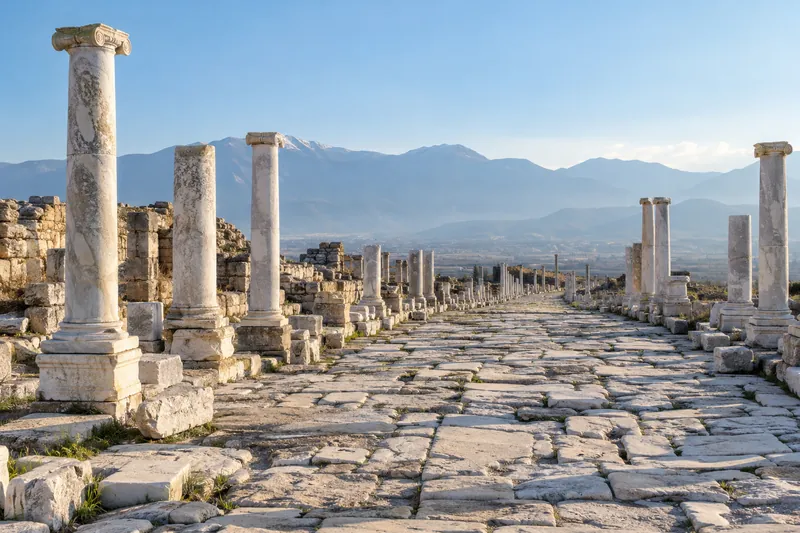
The Asclepion was a healing sanctuary of Asclepius, the god of medicine, founded in the 4th century BC and greatly expanded in the Roman period. Patients walked in along the Via Tecta, a sacred road about two-thirds of a mile (1 km) long, and were treated with spring water, baths, diet and dream interpretation. Galen, the most influential physician of the Roman world, was born in Pergamon and worked here, treating gladiators before he served emperors. Look for the sacred spring, the small theater for about 3,500 people, the round Temple of Telesphorus and the vaulted underground passage leading to it.
Bergama Archaeology Museum
The Bergama Museum opened in 1936 and holds finds from Pergamon and the surrounding area, including sculpture, Pergamon pottery and the cistophoric coins first minted here. An ethnography section shows local Yörük and Turkmen dress, carpets and saddlebags. Its long hours make it a good last stop.
Tickets and opening hours (as of October 2026)
Foreign visitor prices at Ministry sites are set in euros and charged in Turkish lira at the daily rate. Children under 8 enter free. The official listings currently show the hours below, but an older Ministry listing gives longer summer hours (08:00–18:30, April to October), so check muze.gov.tr the week you travel.
| Site |
Ticket for foreign visitors |
Hours |
Notes |
| Pergamon Acropolis |
€15 |
08:30–17:30, ticket office closes 17:00 |
Open daily. Audio guide available |
| Asclepion |
€13 |
08:30–17:30, ticket office closes 17:00 |
Open daily |
| Red Basilica (Kızıl Avlu) |
|
08:30–17:30, ticket office closes 17:00 |
In the town center |
| Bergama Archaeology Museum |
|
08:30–20:00, ticket office closes 19:30 |
Open daily |
| Acropolis cable car |
|
|
Municipal; not covered by museum passes |
Passes: The Museum Pass The Aegean (7 days) is listed at €95 and covers more than 40 sites in the region, including Ephesus. Whether it covers every Bergama site:. A new Ministry tariff takes effect on April 1, 2027, so prices will rise next spring.
Best time to visit
April, May, late September and October are the most pleasant months. Summer is hot and the Acropolis has almost no shade, so in July and August start at opening time.
| Months |
Weather |
Crowds |
Notes |
| March–April |
Mild, some rain |
Light |
Green hills, good for photos |
| May–early June |
Warm and dry |
Light to moderate |
A strong all-round choice |
| Late June–August |
Hot, often 90s°F (mid-30s°C) |
Moderate |
Acropolis early, museum in the heat of the day |
| September–October |
Warm, drying out |
Light to moderate |
Soft light on the theater |
| November–February |
Cool, wet spells |
Very light |
Windy on the hilltop, dress warmly |
Ephesus vs. Pergamon: do you need both?
If you have time for only one, choose Ephesus for completeness and Pergamon for setting. Ephesus is a full Roman city street you walk through. Pergamon is a royal hilltop capital, more dramatic and much quieter.
|
Ephesus |
Pergamon |
| Character |
Complete Roman city on flat to gently sloping ground |
Hellenistic royal capital on a steep hill |
| Highlights |
Library of Celsus, Terrace Houses, Great Theater |
Steep theater, Trajan temple, Asclepion, Red Basilica |
| Crowds |
Heavy, especially on cruise days |
Usually light |
| Bible links |
Paul, Acts 19, first of the seven churches |
Third of the seven churches, Revelation 2:12–17 |
| Time needed |
Full day |
Most of a day |
For history and Seven Churches travelers, both are worthwhile.
Guide's tip
Do the Acropolis first, as early as you can, while it is cool and before the light flattens. Then drive down to the Asclepion and finish at the Red Basilica and museum in town. On the Acropolis, follow the path downhill from the Trajan temple to the top of the theater, then decide on the spot how far down the steps you want to go.
Practical tips
- Shoes: Wear sturdy closed shoes with good grip. The Acropolis paths are uneven and the theater steps are high and steep.
- Heat and sun: Bring water, a hat and sunscreen. There is very little shade on the hilltop.
- Dress code: Casual clothes are fine at all the archaeological sites. Cover shoulders and knees if you visit a mosque in town, and women need a headscarf inside.
- Accessibility: The Acropolis and the theater are hard for anyone with limited mobility. The Red Basilica and the museum are much easier. Ask us about routes.
- Cash: Ticket desks take cards, but carry some Turkish lira for the cable car, parking, snacks and small shops.
- Tipping: For a private guide and driver, tips are customary and appreciated. Your guide can advise on local norms.
- Photography: Personal photos are fine at the sites. Drones need permission and are not allowed without it.
Common myths about Pergamon
- Myth: The Pergamon Altar is in Pergamon. Fact: The Great Altar of Pergamon was excavated in the 19th century and taken to Berlin, where it is part of the Pergamon Museum collection. Its foundations remain on the Acropolis.
Sources
- Pergamon and its Multi-Layered Cultural Landscape, UNESCO World Heritage Centre
- Bergama Acropolis Archaeological Site, official page (Ministry of Culture and Tourism)
- Bergama Asklepion Archaeological Site, official page (Ministry of Culture and Tourism)
- Bergama Kızılavlu (Basilica) Archaeological Site, official page (Ministry of Culture and Tourism)
- Bergama Museum, official page (Ministry of Culture and Tourism)
- İzmir Bergama Pergamon Acropolis, Turkish Museums (Ministry portal)
- İzmir Bergama Asklepion, Turkish Museums (Ministry portal)
- Kızıl Avlu, Kültür Envanteri
- Bergama Acropolis Gondola (Wikipedia)
- The Pergamonmuseum returns: opening on June 4, 2027 (Staatliche Museen zu Berlin)
- 2026 museum and archaeological site ticket prices (Karekod)
- 2027 museum tariff tables, effective April 1, 2027 (Alomaliye)
- Bergama (Pergamum) travel notes (Turkey Travel Planner)
- Revelation 2 (Bible Gateway, ESV)
FAQ
Is Pergamon worth visiting?
Yes, especially if you enjoy ancient history or are following the Seven Churches of Revelation. Pergamon has one of the most dramatic settings of any ancient site in Turkey, a UNESCO listing since 2014 and far fewer visitors than Ephesus. The steep theater, the Trajan temple and the Asclepion together tell a story you will not get at other sites.
How long do you need in Pergamon?
Plan 5 to 6 hours to see the Acropolis, the Asclepion and the Red Basilica at a steady pace, plus about 45 minutes if you add the Bergama Museum. Many travelers combine Pergamon with a drive from Troy or to Ephesus, which makes it a full travel day with an overnight stop on either side.
Can you visit Pergamon as a day trip from İzmir?
Yes. Bergama is about 62 miles (100 km) north of İzmir, roughly 1.5 hours by car each way. A day trip easily covers the Acropolis, the Asclepion and the Red Basilica, with time for lunch in town. A private driver helps, since the sites are spread out and public transport between them is limited.
Can you visit Pergamon from Kuşadası or Ephesus?
You can, but it is a long day. Bergama is about 2.5 hours by road from Kuşadası and Selçuk each way. Doing both Pergamon and Ephesus in one day is not practical. It works better to see Pergamon on the way between Troy and Ephesus, or to give it its own day from İzmir.
What is "Satan's throne" in Pergamon?
Revelation 2:13 says the church at Pergamum lived "where Satan's throne is." The text does not say what it means. Common interpretations point to the Great Altar of Zeus, the Roman emperor cult with its temples on the Acropolis, the healing cult of Asclepius, or Pergamon's status as a center of Roman power in the province.
Where is the Pergamon Altar now?
The reliefs of the Great Altar were excavated by German archaeologists in the late 19th century and are in the Pergamonmuseum in Berlin. Only the foundation platform remains on the Acropolis. The Berlin museum has been closed for renovation and is scheduled to reopen on June 4, 2027, with the altar back on view.
Is there a cable car to the Pergamon Acropolis?
Yes. A cable car opened in 2010 and runs from the lower town to near the Acropolis entrance in about four minutes. It needs a separate ticket from the site entry. With a private vehicle you can also drive up to the parking area near the entrance, which helps on very hot or windy days.
How do you get to Pergamon?
Pergamon sits on and around a steep hill above Bergama, a market town in the north of İzmir Province. The usual approach is by road from İzmir, or as a stop on the drive between Troy (Çanakkale) and Ephesus. From İzmir city: about 62 miles (100 km), roughly 1.5 hours by car.
When is the best time to visit Pergamon?
April, May, late September and October are the most pleasant months. Summer is hot and the Acropolis has almost no shade, so in July and August start at opening time.
Is Pergamon a UNESCO World Heritage Site?
Yes. It is on the UNESCO World Heritage List as “Pergamon and its Multi-Layered Cultural Landscape”, inscribed in 2014.
Which private tours include Pergamon?
Several of our private tours include Pergamon, starting from 5 days. They are listed at the top of this page with routes and prices per person.