
Ancient sites
Beyond the White Terraces: Hierapolis, Laodicea and Aphrodisias
By Osman DemirLicensed national guide · 15 years
Short answer: Pamukkale’s white terraces are only part of the story. Above them lies Hierapolis, a large Roman spa city with a theater, a 2 km necropolis and the Martyrium of St. Philip; 15 to 20 minutes away is Laodicea, one of the Seven Churches of Revelation; and about two hours west is Aphrodisias, a UNESCO site since 2017. Hierapolis and Laodicea fit in one full day, and adding Aphrodisias makes it two.
Most visitors give Pamukkale two hours: a walk on the travertines, a few photos and back on the bus. That is a pity, because the area around it holds three of the most rewarding ancient cities in western Turkey. Here is how I suggest seeing them, what each one offers, and how to fit them into one or two days. For the basics of the terraces themselves, see our Pamukkale guide.
What is there to see in Hierapolis beyond the terraces?
Hierapolis is a full Roman city spread along the ridge above the travertines, and it deserves at least three hours. The Attalid kings of Pergamon founded it as a thermal spa at the end of the 2nd century BC, and UNESCO inscribed Hierapolis-Pamukkale as a World Heritage Site in 1988.
The theater
The Roman theater sits on the hillside east of the main street and is one of the highlights of the site. Much of its stage building has been restored, with carved reliefs back in place, and from the upper rows you look out over the whole valley. The climb is steep in summer heat, so go early or late.
The necropolis
The northern necropolis stretches for more than 2 km along the road toward the North Gate, with hundreds of tombs: simple sarcophagi, house-shaped tombs and round tumuli. Many people came to Hierapolis for the healing waters and some never left, which is one reason the cemetery is so large. Walking through it from the North Gate is one of the quietest parts of a visit.
Martyrium of St. Philip
On the hill above the theater stands the Martyrium of St. Philip, an octagonal early Christian pilgrimage building linked to the apostle Philip, who according to tradition died in Hierapolis. UNESCO singles it out as a significant piece of early Christian architecture. In 2011 an Italian team led by Professor Francesco D’Andria announced the discovery of a tomb they identified as Philip’s, inside a church close to the Martyrium. For faith travelers, this is often the most meaningful stop of the day.
Hierapolis Archaeology Museum
The museum occupies part of the former Roman baths, near the Antique Pool. It holds sarcophagi, statues and the carved reliefs from the theater. Allow 30 to 45 minutes. It also makes a good shaded break at midday.
Is Cleopatra’s Pool worth it?
The Antique Pool, popularly called Cleopatra’s Pool, is a warm thermal spring where you swim over fallen marble columns. It needs a separate ticket from the main site, and it is worth it if you enjoy a swim; skip it if you are short of time.
The pool reopened in May 2026 after renovation work that began in January 2025. As of October 2026, the reported foreign visitor price is 600 Turkish lira, with children up to age 6 free. There is no historical evidence for the Cleopatra legend, but the setting is real enough. Bring a swimsuit and towel, and expect midday crowds in summer.
What is the barefoot rule on the travertines?
Shoes are not allowed on the travertine terraces. You walk the marked path barefoot or in socks, and site guards enforce the rule to protect the calcium deposits.
Carry a small bag for your shoes. The surface is ridged in places and slippery where water runs, so walk slowly. Many pools are kept dry in rotation for conservation, so the amount of water you see changes by season and by section. Stay on the open path, as walking on closed areas is not permitted.
When should you go, and what should you bring?
April to early June and September to October are the most comfortable months for all three sites. In July and August, the white rock of Pamukkale reflects strong sun, and Laodicea and Aphrodisias have very little shade.
In the hot months, plan the open sites for the first and last hours of the day and save the museums and the pool for midday. Whatever the season, bring:
- Sunglasses, a hat and sunscreen. The glare on the travertines is intense.
- Walking shoes for the ruins, plus a bag to carry them on the terraces.
- At least a liter of water per person; cafés exist at Hierapolis but are spread out.
- A swimsuit and quick-dry towel if you plan to use the Antique Pool.
Why visit Laodicea?
Laodicea is one of the Seven Churches of Revelation and one of the most actively excavated Roman cities in Turkey. It lies a short drive south of Pamukkale and needs about 1.5 to 2 hours.
In Revelation 3:14 to 22, the letter to the church in Laodicea rebukes a congregation that is “neither cold nor hot” and that considers itself rich and in need of nothing. A common reading connects the “lukewarm” image to the city’s water supply, though scholars debate the details. Standing in Laodicea, with the white cliffs of Hierapolis visible across the valley, the passage becomes very concrete.
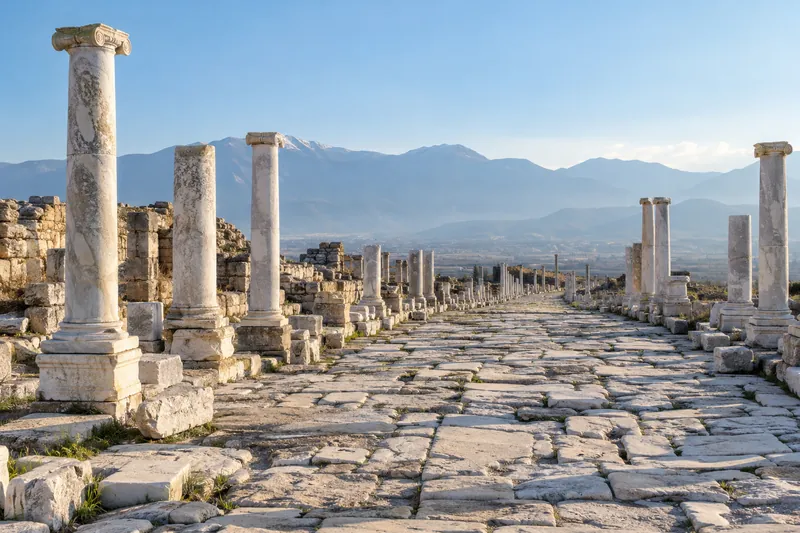
Systematic excavations began in 2003 under Pamukkale University and the Ministry of Culture and Tourism, led by Professor Celal Şimşek, and since 2008 work has continued year round. You walk along the colonnaded Syria Street with its restored columns, see the large stadium, two theaters and temples, and visit the Laodicea Church, an early church now protected by a modern roof. For the wider faith route, see our Seven Churches of Revelation guide.
What makes Aphrodisias special?
Aphrodisias is a city devoted to the goddess Aphrodite and famous for its school of sculptors, who worked marble from quarries just outside the walls. UNESCO inscribed it in 2017, listing both the city and the marble quarries.
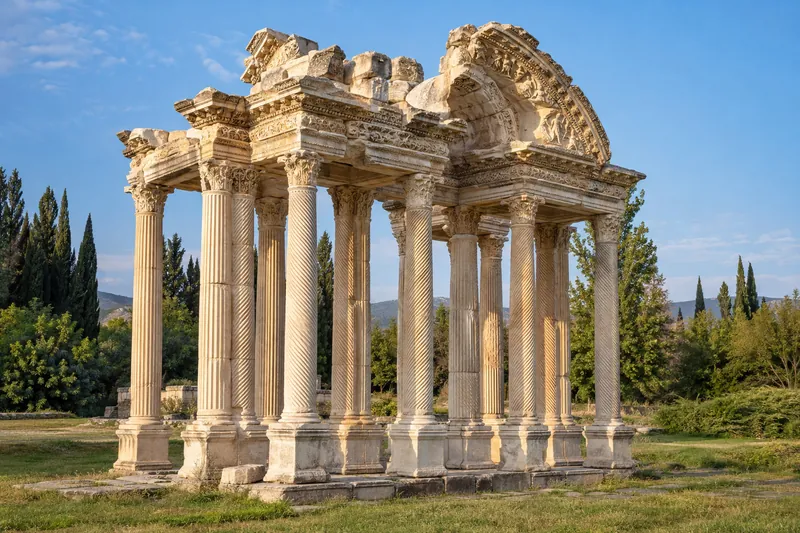
- Tetrapylon: The monumental gateway to the sanctuary of Aphrodite, built around AD 200, with finely carved columns and pediments.
- Stadium: About 270 meters long, with rounded ends and seating for an estimated 30,000. UNESCO calls it the best-preserved example of its type in the ancient world.
- Temple of Aphrodite: Converted into a church around AD 500, an unusual case that UNESCO highlights.
- Sebasteion: A complex built for the cult of Augustus and the Julio-Claudian emperors. Its carved relief panels, showing emperors, gods and myths, are displayed in the Sevgi Gönül Hall of the site museum. Do not skip the museum; for many visitors it is the highlight.
Aphrodisias lies near the village of Geyre in Aydın province. Allow 2 to 3 hours at the site, including the museum.
Tickets as of October 2026
The Ministry of Culture and Tourism prices foreign visitor tickets in euros, charged in Turkish lira at the daily rate. A new tariff takes effect on April 1, 2027.
| Site | Foreign visitor ticket, October 2026 | From April 1, 2027 |
|---|---|---|
| Hierapolis-Pamukkale (terraces and ancient city) | €30 | €35 |
| Antique Pool | 600 TL (separate operator) | Not announced |
| Laodicea | €12 | €13 |
| Aphrodisias museum and site | €12 | €13 |
Opening hours shift with the season. Laodicea, for example, keeps winter hours of 08:00 to 17:00 from October 1. Check the official listing the week you travel.
How do you fit them into one or two days?
Hierapolis and Laodicea fit comfortably into one full day. Aphrodisias adds roughly two hours of driving each way from Pamukkale, so it fits most easily as a stop on the road between Ephesus and Pamukkale.
One day: Hierapolis and Laodicea
- Start at Laodicea at opening time, while it is cool, and spend about two hours.
- Drive up to the South Gate of Hierapolis. Walk the main street, the theater and the Martyrium.
- Midday: the museum, lunch, and the Antique Pool if you want a swim.
- Late afternoon: walk down the travertines barefoot toward the village, when the rock is cooler underfoot and the light is softer.
Two days: adding Aphrodisias
Coming from the Ephesus area, leave early, spend the late morning at Aphrodisias, and continue to Pamukkale for the night. The next day follows the one-day plan above. Travelers based in Selçuk for Ephesus can also visit Aphrodisias on the way east, which avoids a separate return trip.
Several of our itineraries pass through Pamukkale, and our 5-day private Seven Churches tour from İzmir includes Laodicea. If you want Aphrodisias as well, build your trip and we will plan the extra day around it.
Sources
- Hierapolis-Pamukkale (UNESCO World Heritage Centre)
- Aphrodisias (UNESCO World Heritage Centre)
- Laodikeia Archaeological Site (Turkish Museums, Ministry of Culture and Tourism)
- Revelation 3:14 to 22 (Bible Gateway)
- Antique Pool reopens with 2026 prices (Pamukkale Haber)
- Denizli site fees for 2027 (Pamukkale Haber)
- Museum and site prices, October 2026 (Karekod)
- Archaeologists report finding St. Philip’s tomb (Vatican Radio, 2011)
FAQ
Is Hierapolis included in the Pamukkale ticket?
Yes. One ticket covers both the travertine terraces and the ancient city of Hierapolis. As of October 2026 it costs €30 for foreign visitors, charged in Turkish lira, rising to €35 from April 1, 2027. The Antique Pool needs a separate ticket, reported at 600 Turkish lira for foreign visitors after it reopened in May 2026.
Do you have to take your shoes off at Pamukkale?
Yes. Shoes are not allowed on the travertine terraces, and guards enforce the rule to protect the calcium deposits. You can walk barefoot or in socks along the marked path. Carry a small bag for your shoes, walk slowly on wet or ridged sections, and stay out of areas closed for conservation.
How far is Laodicea from Pamukkale?
Laodicea lies a short drive south of Pamukkale, about 15 to 20 minutes by car. It is one of the Seven Churches of Revelation and needs about 1.5 to 2 hours. Starting there at opening time and then driving up to Hierapolis makes a comfortable full day that covers both sites.
Can you visit Aphrodisias as a day trip from Pamukkale?
Yes, but it means roughly two hours of driving each way plus 2 to 3 hours at the site. A better plan for most travelers is to stop at Aphrodisias on the road from the Ephesus area to Pamukkale. That way the visit replaces a long return trip and fits naturally into a two-day plan.
Why is Laodicea important for Christians?
Laodicea is the seventh of the Seven Churches addressed in the Book of Revelation. In Revelation 3:14 to 22, the church is rebuked for being lukewarm, neither cold nor hot. Excavations since 2003 have uncovered streets, theaters, a large stadium and an early church, which helps visitors picture the city the letter was written to.
Summarize this post with an AI assistant
Private tours that go there
Every tour runs with your own licensed guide and vehicle, and every one can be adjusted.
5-Day Private Seven Churches of Revelation Tour from İzmir
Seven Churches of Revelation · İzmir · Pergamon · Sardis · Philadelphia (Alaşehir) · Laodicea
Includes: 4-star hotels · Entrance fees
5-Day Private Seven Churches of Revelation Tour from Istanbul
Seven Churches of Revelation · İzmir · Pergamon · Sardis · Philadelphia (Alaşehir) · Laodicea
Includes: 4-star hotels · Domestic flights · Entrance fees
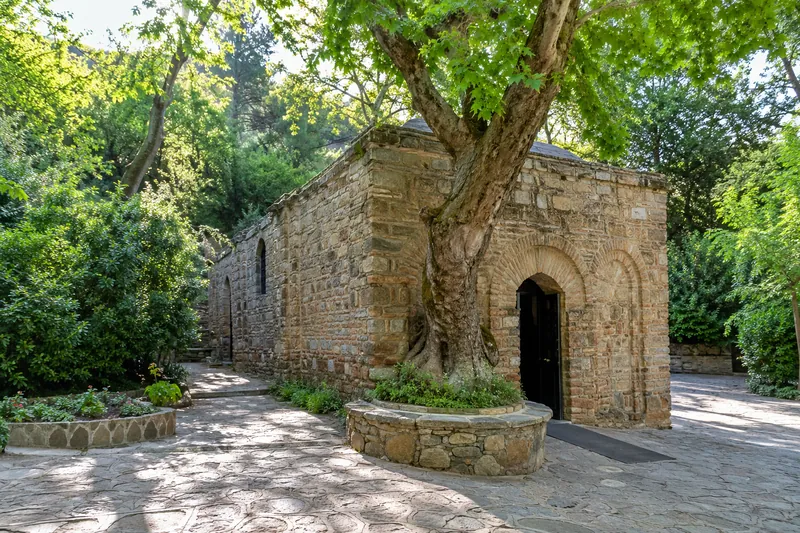
10-Day Private Seven Churches Tour with Istanbul & Cappadocia
Istanbul · Cappadocia · Seven Churches of Revelation · İzmir · Pergamon · Sardis
Includes: 4-star hotels · Domestic flights · Entrance fees
More from the blog
All articles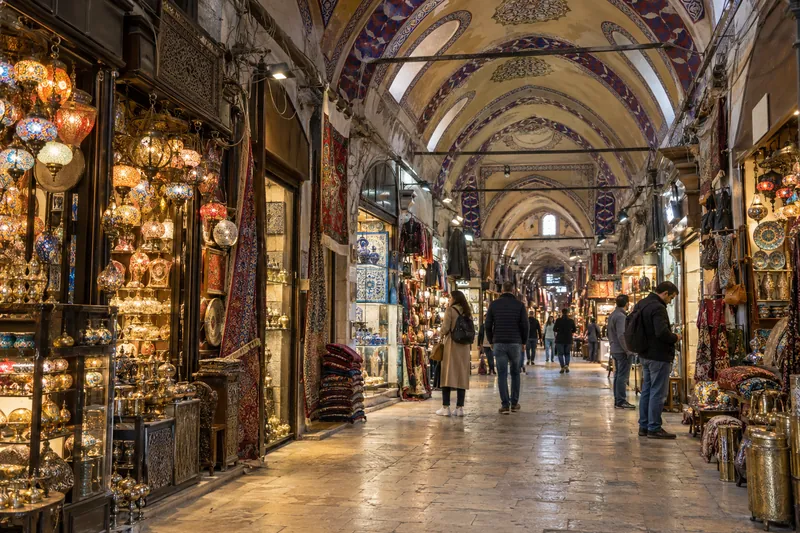
Turkey Itinerary Mistakes We See Most Often and How to Avoid Them
Ten common Turkey itinerary mistakes, from driving to Cappadocia to Tuesday at Topkapı, and the simple fix for each one.
 Evren SatırFounder, Turkey Itineraries · 7 min read
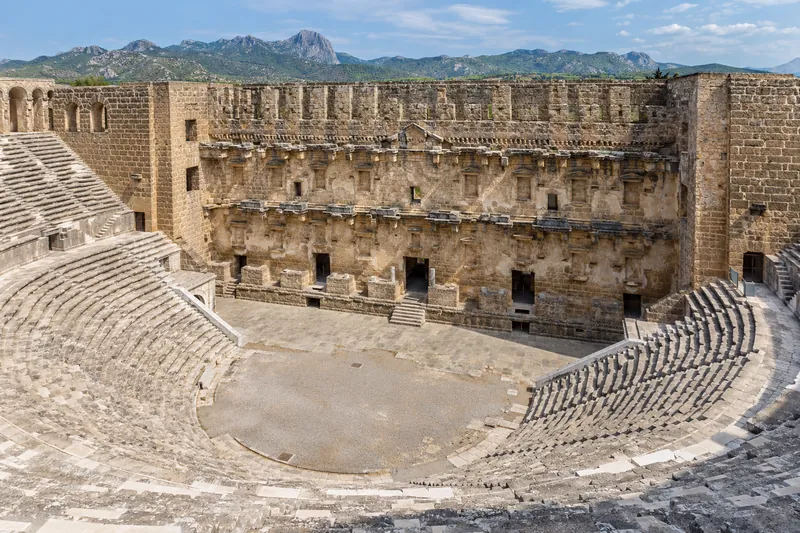
Antalya’s Ancient Cities in One Day: Perge, Aspendos and Side
The right order, driving times, October 2026 tickets and what to skip on a day trip to Perge, Aspendos and Side from Antalya.
Osman DemirLicensed guide · 6 min read
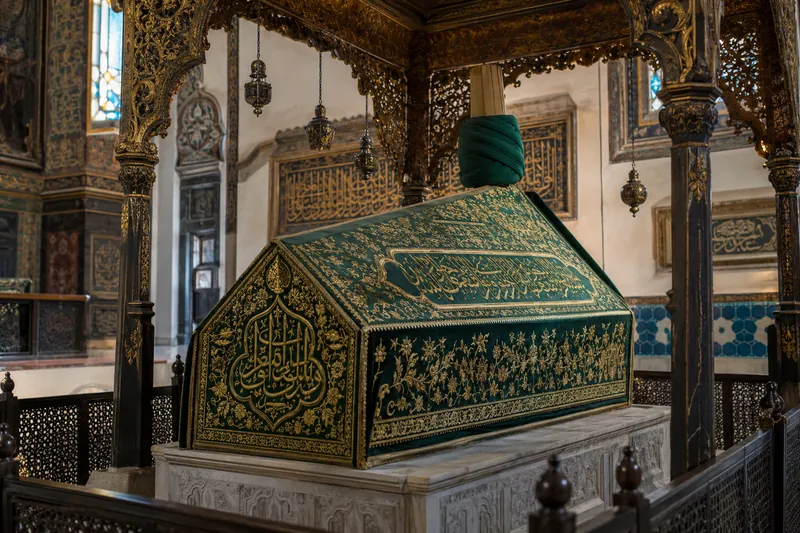
Visiting Konya: Rumi’s Tomb, the Sema Ceremony and Seljuk Sites
Rumi's tomb, a real Saturday sema, Seljuk tilework and a plate of etli ekmek: how to spend a night in Konya between Cappadocia and Pamukkale.
 Bahar ÖzdemirLicensed guide · 7 min read